ChipApex | Global Electronic Components Supplier
SEARCH
Search Product
Search Post
— IC芯片 | 连接器 | 传感器 | 被动器件 —
Search productSearch post
— IC芯片 | 连接器 | 传感器 | 被动器件 —
Consult the customer manager about the wholesale price.
consultation hotline:86-132-6715-2157
email:[email protected]
Contact the product manager for consultation. One-stop consultation is available.
Do you want a lower wholesale price? Please send us your inquiry and we will reply immediately.
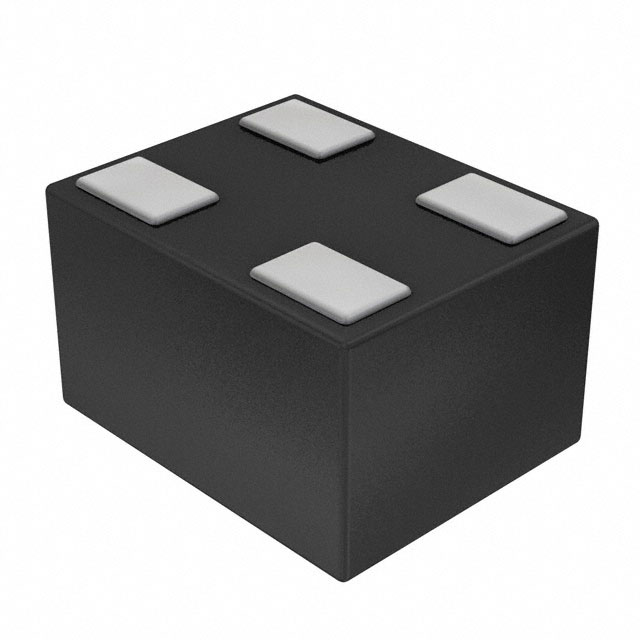
The UNRL21300A is a composite device featuring an NPN silicon epitaxial planar transistor with built-in bias resistors, designed for digital circuits. It utilizes the ML4-N1 leadless package to minimize PCB footprint and enable automated tape packing. Key electrical ratings include a collector-to-emitter voltage of 50 V, a maximum collector current of 100 mA, and a total power dissipation of 150 mW at 25°C. The component incorporates two internal resistors (R1 and R2), both specified at 47 kΩ with a resistance ratio tolerance centered around 1.0. The forward current transfer ratio (hFE) ranges from 80 to 460 under standard test conditions.
Verify the specific suffix '00A' against the manufacturer's official documentation, as the primary datasheet covers the UNRL213 variant without this suffix. Confirm current lifecycle status, as the source indicates potential maintenance or discontinuation phases for the series. Ensure the required resistor tolerance and hFE range align with the standard UNRL213 specifications provided in the technical data.
Select this component when a compact NPN switch with integrated biasing is required for digital signals. The 47 kΩ resistor values are suitable for standard logic levels. Verify that the 100 mA collector current and 50 V voltage ratings exceed the application's peak operating requirements. Consider the ML4-N1 package dimensions if board space is constrained compared to traditional leaded packages.
This part belongs to the Panasonic UNRL21x series of composite transistors with built-in resistors. The series includes variants like UNRL210, UNRL211, UNRL213, UNRL214, UNRL215, and UNRL216, which differ primarily in their internal resistor configurations and ratios. All share the same ML4-N1 package and core transistor characteristics.
Direct replacements must match the NPN configuration, 50V/100mA ratings, and ML4-N1 package. Variants within the UNRL21x series may be compatible if the internal resistor values (e.g., 47kΩ/47kΩ) match the design requirements. Verify pinout compatibility and thermal performance before substitution.
 UNRL21300A
The activity of extra discounts on wholesale prices is in full swing…
Please fill in your contact information and we will send you the latest wholesale price list.