 ChipApex | Global Electronic Components Supplier
SEARCH
Search Product
Search Post
— IC芯片 | 连接器 | 传感器 | 被动器件 —
Search productSearch post
— IC芯片 | 连接器 | 传感器 | 被动器件 —
Consult the customer manager about the wholesale price.
consultation hotline:86-132-6715-2157
email:[email protected]
Contact the product manager for consultation. One-stop consultation is available.
Do you want a lower wholesale price? Please send us your inquiry and we will reply immediately.
The VFC320CP is a monolithic voltage-to-frequency and frequency-to-voltage converter manufactured by Texas Instruments. It provides a low-cost method for converting analog signals into digital pulses or vice versa. The device operates with a full-scale frequency of 1 MHz and exhibits an integral nonlinearity (INL) of ±0.1% FSR. It supports a maximum supply voltage of 40 V and a minimum of 6 V, functioning with single or dual power supplies. The component is designed for operation within a temperature range of -40°C to +85°C and is available in a 14-pin PDIP package.
Verify the specific suffix 'CP' confirms the 14-pin PDIP package and commercial/industrial temperature rating as documented in official datasheets. Confirm supply voltage requirements match the 6V to 40V operational range. Ensure pinout compatibility with existing PCB layouts before procurement.
Select this component when high-accuracy analog-to-digital conversion via frequency domain is required. The 1 MHz bandwidth suits moderate-speed applications. Verify that the 14-pin PDIP form factor fits the mechanical constraints. Check if the ±0.1% INL meets system precision needs compared to other family members like LM331.
The VFC320 belongs to Texas Instruments' broader family of voltage-to-frequency converters, which includes parts like the LM331 and VFC32. These devices share similar functional principles but vary in accuracy, speed, and packaging. The VFC320 specifically targets applications requiring reliable F/V and V/F conversion with moderate precision.
Official substitutes include the LM331 and VFC32 from the same manufacturer. Verify pinout compatibility and electrical parameter alignment, such as supply voltage limits and linearity specifications, before substituting.
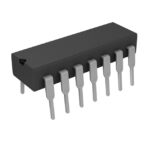 VFC320CP
The activity of extra discounts on wholesale prices is in full swing…
Please fill in your contact information and we will send you the latest wholesale price list.





