 ChipApex | Global Electronic Components Supplier
SEARCH
Search Product
Search Post
— IC芯片 | 连接器 | 传感器 | 被动器件 —
Search productSearch post
— IC芯片 | 连接器 | 传感器 | 被动器件 —
Consult the customer manager about the wholesale price.
consultation hotline:86-132-6715-2157
email:[email protected]
Contact the product manager for consultation. One-stop consultation is available.
Do you want a lower wholesale price? Please send us your inquiry and we will reply immediately.
The W5100 is a single-chip Ethernet controller integrating a full hardware TCP/IP stack, MAC, and PHY. It supports 10/100 Mbps Ethernet standards (IEEE 802.3 10BASE-T and 802.3u 100BASE-TX) with data rates up to 25 Mbps. The chip provides four independent hardware sockets for simultaneous connections and includes 16 KB of internal memory for data transmission. It operates at 3.3 V DC with 5 V tolerant I/Os and features SPI, direct parallel, and indirect parallel interfaces. Supported protocols include TCP, UDP, IPv4, ICMP, ARP, IGMP, and PPPoE.
Verify the specific package variant, as the W5100 is available in LQFP-80. Confirm voltage compatibility, noting the 3.3 V core with 5 V tolerant I/Os. Ensure the selected component matches the required interface mode (SPI or parallel) for the target microcontroller design. Check for RoHS compliance status if environmental regulations apply to the final product assembly.
Select the W5100 for applications prioritizing cost-effectiveness and stability over high throughput. It is suitable for projects with limited MCU resources due to its hardware protocol offloading. Consider the LQFP-80 package size constraints during PCB layout. For higher performance or smaller footprints, evaluate successors like the W5200 or W5500, which offer increased socket counts and reduced package sizes.
The W5100 is part of the WIZnet iEthernet series, serving as a foundational model for hard-wired TCP/IP solutions. It succeeded the W3150A+ by integrating the RTL8201CP PHY core. This chip established the company's TOE (TCP/IP Offload Engine) technology approach, enabling microcontrollers to handle application logic while the W5100 manages network communication tasks entirely in hardware.
The W5100S is a pin-compatible successor offering improved performance. For space-constrained designs, the W5200 provides a QFN-48-EP footprint with doubled socket capacity. High-throughput requirements may necessitate the W5300 or W5500, which feature larger buffers and advanced interface capabilities compared to the original W5100 architecture.
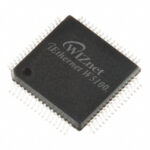 W5100
W5100
The activity of extra discounts on wholesale prices is in full swing…
Please fill in your contact information and we will send you the latest wholesale price list.





