 ChipApex | Global Electronic Components Supplier
SEARCH
Search Product
Search Post
— IC芯片 | 连接器 | 传感器 | 被动器件 —
Search productSearch post
— IC芯片 | 连接器 | 传感器 | 被动器件 —
Consult the customer manager about the wholesale price.
consultation hotline:86-132-6715-2157
email:[email protected]
Contact the product manager for consultation. One-stop consultation is available.
Do you want a lower wholesale price? Please send us your inquiry and we will reply immediately.
The ZX85-40W-63-S+ is a coaxial bias-tee from the Mini-Circuits ZX85 series, designed for high-power RF applications. It operates within a frequency range of 700 MHz to 6 GHz and maintains a 50 Ohm impedance. The component features SMA connectors on all three ports (input, output, and DC). It supports a maximum continuous RF power handling of 40 Watts. Voltage Standing Wave Ratio (VSWR) specifications are typically 1.1:1 and 1.2:1 across the operating band.
Verify the specific datasheet version for the ZX85-40W-63-S+ prior to ordering, as Mini-Circuits may update electrical characteristics or mechanical drawings over time. Confirm that the 40W power rating aligns with your system's peak and average power requirements. Ensure connector gender and polarity match your existing cable infrastructure. Check for any recent supply chain advisories or lead time changes directly from authorized distributors.
Select this model when high RF power handling is critical within the 700 MHz to 6 GHz spectrum. Compare VSWR performance against other bias-tees if signal integrity is paramount. Consider the SMA connector type for compatibility with standard test equipment and cabling. Evaluate thermal management needs given the 40W power dissipation. Alternative lower-power models exist if the 40W rating exceeds actual system requirements.
This component belongs to the ZX85 series of bias-tees from Mini-Circuits, which are engineered for general-purpose RF applications requiring reliable DC injection. The series includes various models with different power ratings and frequency ranges. The ZX85-40W-63-S+ specifically addresses high-power scenarios, distinguishing it from lower-wattage variants in the same family.
Direct substitutes include other ZX85 series models such as ZX85-40G-S+ or ZX85-63-S+, depending on specific frequency or power adjustments. Verify that alternative part numbers maintain the required 40W power handling and SMA connectivity. Cross-reference datasheets to ensure VSWR and frequency range specifications meet application constraints.
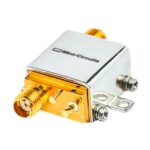 ZX85-40W-63-S+
The activity of extra discounts on wholesale prices is in full swing…
Please fill in your contact information and we will send you the latest wholesale price list.





