 ChipApex | Global Electronic Components Supplier
SEARCH
Search Product
Search Post
— IC芯片 | 连接器 | 传感器 | 被动器件 —
Search productSearch post
— IC芯片 | 连接器 | 传感器 | 被动器件 —
The trend of science and technology is changing rapidly.
Date: May 13, 2026
The global memory industry is facing an unprecedented supply crunch in legacy MLC NAND Flash. Leading manufacturers including Samsung Electronics and Kioxia are steadily exiting the MLC NAND market, shifting capacity focus to high-margin AI memory products such as HBM and advanced 3D NAND.
Since late 2025, the continuous capacity withdrawal has pushed mainstream MLC NAND spot prices up more than 300%. Industrial, automotive, and medical device manufacturers — which rely heavily on MLC’s high endurance and long-term operational stability — are now rushing to secure stock allocations amid shrinking supply.
Samsung officially launched the phase-out of its last 2D NAND production line in March 2026, with all final shipments scheduled for June 2026.
The involved fab previously produced 80,000–100,000 wafers per month, and will be refurbished to produce 1c DRAM for AI server applications.
This strategic move ends Samsung’s 24-year history in the 2D NAND sector, wiping out roughly 20% of global 2D NAND capacity in a short period.
In an official customer notification dated March 2026, Kioxia confirmed a complete withdrawal from the 2D NAND market, covering MLC, SLC and TLC across 32nm, 24nm and 15nm process nodes.
Key Phase-Out Schedule:
The exit applies to all product formats: bare wafers, BGA/TSOP packages, eMMC and UFS components.
Micron has significantly cut MLC NAND output and downsized consumer SSD lines, reallocating wafer resources to AI data center memory solutions.
SK hynix also limits MLC production only to existing long-term customer commitments, with no further capacity expansion plans.
Per TrendForce industry data, global MLC NAND capacity is set to drop 41.7% year-on-year in 2026. Samsung and Micron continue to withhold core MLC manufacturing technology licensing, leaving no new suppliers able to fill the supply gap quickly.
Typical Price Movement:
Downstream panic buying and safety stock replenishment have further accelerated the price uptrend, while component lead times keep extending for industrial-grade MLC NAND.
Industry analysts and TrendForce forecast the MLC NAND shortage will worsen in H2 2026, with the legacy memory supply gap expanding to around 40%.
As Kioxia gradually winds down shipments and no viable mass-production alternatives emerge, MLC NAND prices are expected to remain at elevated levels throughout 2027–2028.
While Taiwanese suppliers such as Macronix have ramped up MLC output, their capacity cannot offset the massive capacity loss from Samsung and Kioxia. The ongoing MLC NAND crisis clearly reflects a major industry shift: AI-driven memory demand is permanently reshaping the supply chain and pricing structure of legacy semiconductor components.
**Source: TrendForce, Industry Disclosures**

Renesas will shut down Takasaki 6-inch wafer fab within 2–3 years while retaining R&D functions. Check the latest semiconductor supply chain impact for automotive and industrial components.
View details
A perfect storm of surging demand and supply chain disruptions is roiling the global electronic components market, with advanced semiconductors and critical materials now as scarce as gold, while Chinese manufacturers are seizing opportunities to...
View details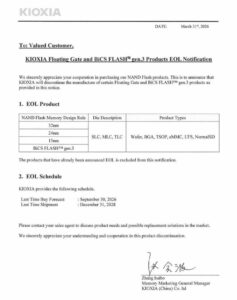
Kioxia officially phases out legacy 2D NAND and third-generation BiCS3 3D NAND production. Read the latest industry update on NAND flash memory transition and market impact.
View details
As 2025 draws to a close, the global semiconductor industry stands at a crossroads. Intertwined with escalating geopolitical tensions, supply chain disruptions, and groundbreaking technological transformations, the market is undergoing a drastic r...
View details
The activity of extra discounts on wholesale prices is in full swing…
Please fill in your contact information and we will send you the latest wholesale price list.