 ChipApex | Global Electronic Components Supplier
SEARCH
Search Product
Search Post
— IC芯片 | 连接器 | 传感器 | 被动器件 —
Search productSearch post
— IC芯片 | 连接器 | 传感器 | 被动器件 —
The trend of science and technology is changing rapidly.
Recently, a survey by the Electronic Components Industry Association (ECIA) revealed that the sales sentiment of global electronic components remained optimistic in the third quarter of 2025 and is expected to continue into the fourth quarter.
Although the overall index dropped from 121.6 in July to 113.2 in August, which was lower than the previous expectation of 127.5, the survey participants generally expected a strong rebound in September, with the overall average expected score reaching 130.2. Among them, passive components and electromechanical components performed the most prominently, with the indices in August being 116.1 and 115.0 respectively, and the semiconductor category having an index of 108.3. Compared with the same period last year, the sales sentiment was even stronger, and the average index of the terminal market in the past three months ranged from 140.0 to 145.2.
In terms of product innovation, according to the report by EEWORLD, several breakthrough products attracted attention at the 2025 International Electronic Components Exhibition. A foreign-funded enterprise exhibited MLCCs (Multi-layer Ceramic Capacitors) in the 01005 specification, which were only 0.4mm × 0.2mm in size, shrinking by more than 50% compared with the traditional 0201 specification. These can help portable devices such as smartwatches and wireless earphones achieve a slimmer design, and the product is expected to enter formal mass production in the third quarter of this year.
In terms of corporate developments, MediaTek announced on its official website that its first flagship system-on-chip (SoC) using TSMC’s 2-nanometer process has successfully completed the design tape-out, becoming one of the first companies in the world to achieve this milestone. The product is expected to enter mass production and be launched on the market by the end of next year. In addition, Samsung Electronics has encountered problems in the commercialization of its ninth-generation (V9) high-capacity QLC NAND flash memory. Due to defects that have led to performance issues, the commercialization time will be postponed until the first half of 2026.
Market analysts pointed out that the current electronic components industry is in a critical period of technological iteration and market restructuring. With the rapid rise of emerging fields such as new energy vehicles, artificial intelligence, and the Internet of Things, the electronic components industry is expected to embrace broader development space.

ON Semiconductor (onsemi) announces price increases for select products starting April 1, 2026, due to rising costs and strong demand in power, industrial & data center markets.
View details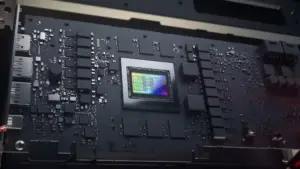
Wolfspeed SiC modules, AMD MI430X with HBM4, TSMC’s Japan expansion, Samsung GDDR7—key semiconductor updates for global buyers in December 2025.
View details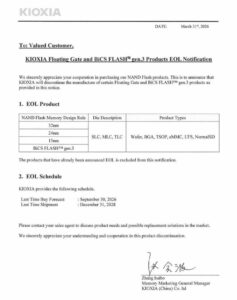
Kioxia officially phases out legacy 2D NAND and third-generation BiCS3 3D NAND production. Read the latest industry update on NAND flash memory transition and market impact.
View details
Global MLCC market faces severe panic buying in Q3 2026. High-end AI server & automotive MLCC lead time up to 16 months, spot prices surge 2-3 times. Get reliable passive component sourcing solutions here.
View details
The activity of extra discounts on wholesale prices is in full swing…
Please fill in your contact information and we will send you the latest wholesale price list.