 ChipApex | Global Electronic Components Supplier
SEARCH
Search Product
Search Post
— IC芯片 | 连接器 | 传感器 | 被动器件 —
Search productSearch post
— IC芯片 | 连接器 | 传感器 | 被动器件 —
The trend of science and technology is changing rapidly.
May 4, 2026 — The global power semiconductor market is grappling with a worsening supply crunch, as lead times for key components have extended to as long as 30 weeks, and major manufacturers including Infineon, Texas Instruments (TI), and STMicroelectronics have launched successive price increases. Driven by the explosive growth of AI data centers, the popularization of 800V high-voltage architectures, and tight mature-process production capacity, the shortage has evolved into a structural imbalance that is expected to persist through the second half of 2026, industry analysts warn.
The supply strain is most evident in mainstream power semiconductor categories.
New Choke Points Emerge: Power management integrated circuits (PMICs) and server management chips (BMCs) have become critical bottlenecks. As AI servers grow increasingly power-hungry—with per-rack power consumption jumping from 30kW to 60-120kW—demand has skyrocketed. Lead times for PMICs have stretched to 35-40 weeks. Samsung’s decision to shut down an 8-inch wafer fab in South Korea has further tightened capacity for these analog/mixed-signal chips.
The shortage has quickly translated into widespread price hikes.
| Manufacturer | Announcement/Effective Date | Price Increase Details |
|---|---|---|
| Infineon | Announced Feb / Effective Apr 1 | Up to 25% on power switches & ICs |
| Texas Instruments | Effective Apr 1 | 5% to 85% on select products |
| Chinese Suppliers | Various (Feb-Apr) | 10% to 20% on MOSFETs & IGBTs |
Note: Other major IDM manufacturers like STMicroelectronics and ON Semiconductor have also issued price adjustment notices.
Industry experts attribute the shortage to three overlapping factors:
The transition toward 800V high-voltage direct current (HVDC) architectures in AI data centers and electric vehicles has amplified demand. NVIDIA has identified 800V HVDC as a core architecture for next-generation AI factories to meet megawatt-level power needs.
This transition has spurred demand for high-voltage power components:
Market Outlook for WBG:
TrendForce predicts the global SiC power component market will reach $5.33 billion in 2026, while the GaN power device market is expected to grow 58% year-on-year to $920 million.
Industry players are scrambling to address the supply gap through investment and consolidation.
Market Projection: Analysts at GII project the global power semiconductor market will grow from $59.77 billion in 2025 to $62.93 billion in 2026. However, the current supply shortage is expected to disrupt production schedules for automotive, industrial automation, and data center construction in the coming months.
“The power semiconductor industry is undergoing a structural transformation driven by AI and electrification,” said an industry insider. “Until new capacity comes online and supply-demand balance is restored, the shortage will remain a key challenge for global manufacturers.”
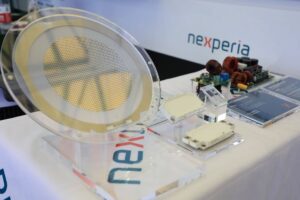
Dutch authorities announced on November 7 the lifting of control measures on Nexperia (formerly NXP Semiconductors' Standard Products division), marking the end of a 39-day supply chain crisis that had threatened global automotive and industrial ...
View details
The semiconductor industry enters the 2nm era in 2025. Rapidus debuts GAA transistors, Samsung launches Exynos 2600, and Infineon & Melexis advance automotive and IoT solutions amid supply chain shifts.
View details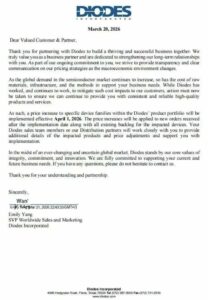
DIODES Incorporated (Nasdaq: DIOD) announces an 8–15% global price increase across discrete, logic, analog, and mixed-signal products, effective April 1, 2026. Driven by raw material costs, logistics, and strong AI/automotive demand.
View details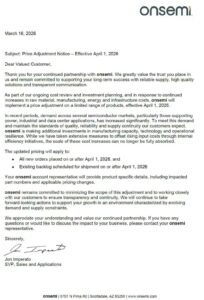
ON Semiconductor (onsemi) announces price increases for select products starting April 1, 2026, due to rising costs and strong demand in power, industrial & data center markets.
View details
The activity of extra discounts on wholesale prices is in full swing…
Please fill in your contact information and we will send you the latest wholesale price list.