 ChipApex | Global Electronic Components Supplier

SEARCH
Search Product
Search Post
— IC芯片 | 连接器 | 传感器 | 被动器件 —
Search productSearch post
— IC芯片 | 连接器 | 传感器 | 被动器件 —
Consult the customer manager about the wholesale price.
consultation hotline:86-132-6715-2157
email:[email protected]
Contact the product manager for consultation. One-stop consultation is available.
Do you want a lower wholesale price? Please send us your inquiry and we will reply immediately.
The Microchip Technology 2N6251 is a high-voltage NPN silicon power bipolar transistor designed for demanding electronic applications. It features a maximum collector current of 10 A and a collector-emitter breakdown voltage of 350 V. The device is housed in a TO-3 metal flange mount package with two pins, facilitating efficient heat dissipation. Qualified per MIL-PRF-19500/510, it supports single-element configurations with a minimum DC current gain of 6. The component exhibits a maximum collector capacitance of 500 pF and connects the case to the collector terminal.
Verify that the specific ordering suffix matches the required military screening level (JAN, JANTX, or JANTXV) as defined by MIL-PRF-19500/510. Confirm lead times and availability directly with authorized distributors, as this component may be subject to long-lead constraints. Ensure the procurement documentation explicitly states the device meets the absolute maximum ratings and electrical characteristics specified in the official datasheet to guarantee performance integrity.
Select the 2N6251 when circuit designs require high voltage blocking capabilities combined with significant current handling in a ruggedized form factor. The TO-3 package is suitable for chassis-mounted applications where thermal resistance is a primary design constraint. Consider the minimum hFE of 6 when designing base drive circuits to ensure adequate saturation or amplification margins under worst-case conditions.
The 2N6251 belongs to a family of high-voltage NPN power transistors originally developed for military and aerospace standards. It shares structural similarities with related part numbers such as the 2N6249 and 2N6250, which offer varying voltage and current specifications within the same qualified series. These devices are engineered to provide reliable switching and amplification in harsh operational environments requiring strict adherence to performance criteria.
Direct substitutes include the 2N6249 and 2N6250 from the same manufacturer's qualified lineup. Verify that alternative parts meet the specific voltage and current requirements of the original design. Cross-referencing with other manufacturers' equivalents requires careful validation of pinout compatibility and thermal characteristics.
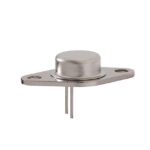 2N6251

The activity of extra discounts on wholesale prices is in full swing…
Please fill in your contact information and we will send you the latest wholesale price list.





