 ChipApex | Global Electronic Components Supplier
SEARCH
Search Product
Search Post
— IC芯片 | 连接器 | 传感器 | 被动器件 —
Search productSearch post
— IC芯片 | 连接器 | 传感器 | 被动器件 —
Consult the customer manager about the wholesale price.
consultation hotline:86-132-6715-2157
email:[email protected]
Contact the product manager for consultation. One-stop consultation is available.
Do you want a lower wholesale price? Please send us your inquiry and we will reply immediately.
The A80 is a cascadable RF amplifier designed for broadband applications spanning 20 to 500 MHz. It utilizes a discrete hybrid design with thin film manufacturing processes to ensure accurate performance and high reliability. The device features a two-stage silicon bipolar feedback architecture, incorporating an isolation transformer in the feedback loop to achieve high reverse isolation. Typical specifications include a gain of 29 dB, a noise figure of 2.3 dB, and a medium-level output power of +14.3 dBm. It is available in hermetically sealed TO-8 and surface mount packages.
Verify the specific package variant required, as both TO-8 and surface mount options are documented. Confirm environmental screening requirements against MIL-STD-883 if applicable for aerospace or defense use cases. Ensure the operating frequency range aligns with the specified 20 to 500 MHz bandwidth. Check datasheet revisions for any updates to electrical characteristics or pin configurations before finalizing procurement.
Select this component when high reverse isolation and low noise are critical for system performance. The cascadable nature allows for flexible gain configuration in multi-stage designs. Consider the thermal and mechanical constraints of the hermetically sealed package during PCB layout. Evaluate the need for MIL-STD-883 screening based on the target application's reliability standards.
MACOM Technology Solutions specializes in high-performance analog semiconductor solutions for RF, microwave, and optical markets. The A80 represents their expertise in discrete hybrid amplifier designs, leveraging thin film technology for precision. This product supports industries such as telecommunications, industrial, and aerospace where reliable broadband amplification is essential.
The A80-1 is a documented similar part number within the MACOM portfolio, also described as a cascadable RF amplifier. Verify electrical parameter compatibility and package dimensions before substitution. Cross-reference datasheets to ensure functional equivalence in the specific application context.
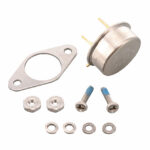 A80
A80
The activity of extra discounts on wholesale prices is in full swing…
Please fill in your contact information and we will send you the latest wholesale price list.





