 ChipApex | Global Electronic Components Supplier
SEARCH
Search Product
Search Post
— IC芯片 | 连接器 | 传感器 | 被动器件 —
Search productSearch post
— IC芯片 | 连接器 | 传感器 | 被动器件 —
Consult the customer manager about the wholesale price.
consultation hotline:86-132-6715-2157
email:[email protected]
Contact the product manager for consultation. One-stop consultation is available.
Do you want a lower wholesale price? Please send us your inquiry and we will reply immediately.
The AD595ADZ is a monolithic instrumentation amplifier and thermocouple cold-junction compensator designed for K-type (Chromel-Alumel) thermocouples. It integrates an ice-point reference with a pre-calibrated amplifier to produce a high-level output of 10 mV/°C directly from the thermocouple signal. The device operates on a single supply ranging from +5 V to +30 V, with typical power consumption under 1 mW. It features a high-impedance differential input to reject common-mode noise and includes a thermocouple open-circuit fault alarm with TTL drive capability. The component is housed in a 14-pin DIP package.
Verify the specific suffix 'ADZ' confirms lead-free and RoHS compliance status as per manufacturer specifications. Confirm the package type corresponds to the standard 14-pin dual in-line configuration. Ensure the operating voltage range aligns with system power rails between 5 V and 30 V. Validate that the K-type calibration matches the installed thermocouple sensor type to prevent measurement errors.
Select this component when direct amplification and compensation of K-type thermocouples are required without external circuitry. It is suitable for applications needing a linear voltage output proportional to temperature. Consider the wide operating temperature range for harsh environments. Evaluate the fault alarm feature if system reliability and open-wire detection are critical design parameters.
This part belongs to the AD594/AD595 family of single-chip thermocouple amplifiers. While the AD594 is calibrated for J-type thermocouples, the AD595 is specifically tuned for K-type inputs. Both share similar architectures including cold-junction compensation and fault alarms, differing primarily in their internal gain calibration to match respective thermocouple voltage-temperature curves.
Yes, while pre-calibrated for K-type, it can be utilized with T-type thermocouples, though external scaling may be necessary for accurate readings.
The fault alarm detects an open thermocouple circuit and provides a TTL-compatible signal to indicate the failure condition.
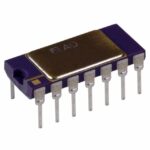 AD595ADZ
The activity of extra discounts on wholesale prices is in full swing…
Please fill in your contact information and we will send you the latest wholesale price list.





