ChipApex | Global Electronic Components Supplier
SEARCH
Search Product
Search Post
— IC芯片 | 连接器 | 传感器 | 被动器件 —
Search productSearch post
— IC芯片 | 连接器 | 传感器 | 被动器件 —
Consult the customer manager about the wholesale price.
consultation hotline:86-132-6715-2157
email:[email protected]
Contact the product manager for consultation. One-stop consultation is available.
Do you want a lower wholesale price? Please send us your inquiry and we will reply immediately.
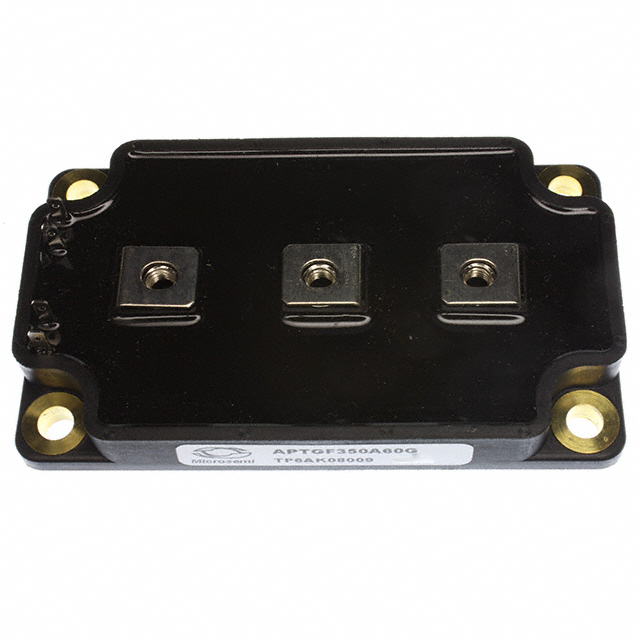
The APTGF350A60G is a phase leg Non-Punch Through (NPT) IGBT power module manufactured by Microsemi. It features a collector-emitter breakdown voltage of 600 V and a continuous collector current rating of 350 A at a case temperature of 80°C. The device supports a maximum power dissipation of 1562 W and operates within a junction temperature range of -40°C to +150°C. Integrated with soft recovery parallel diodes, the module provides low forward voltage drop and tail current. It utilizes an SP6 isolated package with M5 power connectors and includes Kelvin emitter connections for optimized gate drive.
Verify component authenticity through authorized Microsemi distributors or official channels. Confirm the specific revision level matches project requirements, as datasheet specifications may be subject to change without notice. Ensure proper electrostatic discharge handling procedures are followed during receipt and storage, as the devices are sensitive to static damage. Validate thermal interface material compatibility with the SP6 package outline before assembly.
Select this module for high-frequency applications operating up to 100 kHz due to its fast switching characteristics. Consider the positive temperature coefficient of VCE(sat) when designing paralleled configurations to ensure stable current sharing. Evaluate the thermal resistance values against the expected heat sink capacity to maintain junction temperatures within the specified safe operating area limits under varying load conditions.
The APTGF350A60G belongs to the NPT IGBT Power Module family produced by Microsemi. This series is characterized by robust performance in high-power conversion environments. The module integrates both the IGBT switch and the anti-parallel diode into a single isolated package, simplifying circuit layout and reducing parasitic inductance compared to discrete component solutions.
Direct substitutes include the APTGF350A60G variant from Microsemi. Other compatible phase leg modules within the same electrical class should be evaluated based on pinout compatibility, thermal resistance metrics, and mechanical dimensions to ensure seamless integration into existing PCB layouts and cooling structures.
 APTGF350A60G
The activity of extra discounts on wholesale prices is in full swing…
Please fill in your contact information and we will send you the latest wholesale price list.