 ChipApex | Global Electronic Components Supplier
SEARCH
Search Product
Search Post
— IC芯片 | 连接器 | 传感器 | 被动器件 —
Search productSearch post
— IC芯片 | 连接器 | 传感器 | 被动器件 —
Consult the customer manager about the wholesale price.
consultation hotline:86-132-6715-2157
email:[email protected]
Contact the product manager for consultation. One-stop consultation is available.
Do you want a lower wholesale price? Please send us your inquiry and we will reply immediately.
The AT17C512-10JC is a 512-kilobit FPGA Configuration EEPROM manufactured by Microchip Technology (formerly Atmel). It provides non-volatile memory for programming Field Programmable Gate Arrays using a simple serial-access procedure. The device operates at a nominal 5V supply voltage and supports In-System Programming via a 2-wire bus. It features a system-friendly READY pin to indicate power stability and allows programmable reset polarity selection through four EEPROM bytes.
Verify the component manufacturer origin, as this part was originally produced by Atmel before its acquisition by Microchip Technology. Confirm the package type matches the required footprint, as the 'JC' suffix denotes a 20-lead PLCC package. Ensure the operating temperature range aligns with commercial specifications if industrial ratings are not required.
Select this component when a cost-effective, high-density serial EEPROM is needed for FPGA configuration. It serves as a drop-in replacement for older PROM technologies like the XC17 series. Consider the AT17LV512 variant if the design requires a 3.3V supply voltage instead of the standard 5V operation provided by the AT17C series.
This device belongs to the AT17 Series of high-density FPGA Configurators. It is designed to store configuration programs for various FPGA families. The series supports cascading capabilities to expand memory capacity beyond single-device limits. It utilizes a low-power CMOS EEPROM process and offers compatibility with industry-standard programmers.
AT17LV512-10JC (3.3V version)
The READY pin is an open-collector output that is driven Low during the power-up reset cycle. It releases (tri-states) when the power-up is complete, signaling to the FPGA that the power level is stable.
Yes, the user can program the reset polarity to be either active High or active Low by writing specific values to four EEPROM bytes during the programming phase.
The Chip Enable Output (CEO) goes Low when the address counter reaches its maximum value. This signal enables the Chip Enable (CE) input of the next configurator in a daisy-chain sequence.
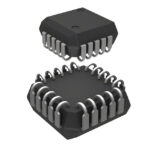 AT17C512-10JC
The activity of extra discounts on wholesale prices is in full swing…
Please fill in your contact information and we will send you the latest wholesale price list.





