 ChipApex | Global Electronic Components Supplier
SEARCH
Search Product
Search Post
— IC芯片 | 连接器 | 传感器 | 被动器件 —
Search productSearch post
— IC芯片 | 连接器 | 传感器 | 被动器件 —
Consult the customer manager about the wholesale price.
consultation hotline:86-132-6715-2157
email:[email protected]
Contact the product manager for consultation. One-stop consultation is available.
Do you want a lower wholesale price? Please send us your inquiry and we will reply immediately.
The AT17F32-30BJU is a 32-Mbit In-System Programmable Configuration PROM packaged in a 44-lead PLCC. It operates at a nominal 3.3V supply voltage with 5V tolerant I/O pins and supports serial download speeds up to 33 MHz. The device features an industrial operating temperature range of -40°C to +85°C, low-power standby mode consuming less than 1 mA, and typical endurance of 10,000 write cycles.
Verify the ordering code AT17F32-30BJU corresponds to the 44-lead PLCC package with Lead and Halide Free (LHF) compliance and Industrial temperature range (-40°C to +85°C). Confirm that the supplier provides documentation consistent with the Microchip/Atmel datasheet specifications for this specific variant.
Select this component when designing systems requiring 32-Mbit capacity for FPGA configuration with 3.3V logic levels. Ensure the design accommodates the 44-lead PLCC footprint and utilizes the 2-wire serial programming interface if ISP capabilities are required. Verify compatibility with the target FPGA's master serial mode requirements.
This device belongs to the AT17F Series of In-System Programmable Configuration PROMs. These configurators provide a solution for loading configuration programs into FPGAs automatically upon power-up or on command. The series is designed for compatibility with various major FPGA families and supports daisy-chaining for larger memory needs.
Compatible with Atmel AT40K and AT94K devices. Also compatible with Altera FLEX, APEX, Stratix, Lattice Semiconductor ORCA, Xilinx Spartan, and Virtex FPGAs.
By setting the PAGE_EN input high, the address space is partitioned into four equal pages. The PAGESEL inputs determine which page is targeted during a serial configuration download.
In a daisy chain, the CEO output goes Low when the internal address counter reaches its maximum value. This signal drives the CE input of the next configurator in the chain, enabling it to output data after the previous device finishes.
Programming is performed via a 2-wire serial bus by bringing the SER_EN input Low. Super voltages required for programming are generated internally, allowing programming at the VCC supply voltage only.
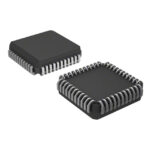 AT17F32-30BJU
The activity of extra discounts on wholesale prices is in full swing…
Please fill in your contact information and we will send you the latest wholesale price list.





