 ChipApex | Global Electronic Components Supplier

SEARCH
Search Product
Search Post
— IC芯片 | 连接器 | 传感器 | 被动器件 —
Search productSearch post
— IC芯片 | 连接器 | 传感器 | 被动器件 —
Consult the customer manager about the wholesale price.
consultation hotline:86-132-6715-2157
email:[email protected]
Contact the product manager for consultation. One-stop consultation is available.
Do you want a lower wholesale price? Please send us your inquiry and we will reply immediately.
The BAT54SHYT116 is a Schottky barrier diode manufactured by ROHM Semiconductor, housed in an SSD3 (SOT-23) surface-mount package. It features a dual series connection configuration with three terminals. Key electrical specifications include a maximum repetitive reverse voltage of 30 V and an average rectified forward current of 0.2 A. The device supports a forward surge current of 0.6 A and exhibits a maximum forward voltage of 0.8 V at 0.1 A. Reverse current is limited to 0.002 mA at 25 V reverse bias. It operates within a junction temperature range up to 150 °C and is supplied in tape-and-reel packaging.
Verify component authenticity through authorized distribution channels. Confirm RoHS compliance status via official documentation. Ensure storage conditions remain within specified limits to maintain device integrity. Check for obsolescence notices as this family may have replacement recommendations. Validate package dimensions against PCB footprint requirements before finalizing procurement.
Select this component for designs requiring a compact Schottky diode with low forward voltage characteristics. The SOT-23 package suits space-constrained layouts. Verify that the 30 V reverse voltage rating meets circuit peak inverse voltage requirements. Consider the 0.2 A average current limit for load compatibility. Ensure thermal management aligns with the 150 °C maximum junction temperature specification.
This part belongs to ROHM's Schottky barrier diode lineup, specifically optimized for low-voltage, high-efficiency rectification. The BAT54SH series utilizes silicon technology to achieve fast switching speeds and minimal power dissipation. The T116 suffix indicates specific tape-and-reel packaging parameters for automated assembly processes.
BAT54SHY is listed as the active replacement for the discontinued BAT54SHM variant. Both share identical pinouts, packages, and electrical specifications. Designers transitioning from older batches should verify that the active version meets all original design constraints without modification.
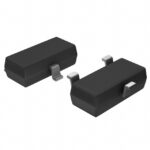 BAT54SHYT116

The activity of extra discounts on wholesale prices is in full swing…
Please fill in your contact information and we will send you the latest wholesale price list.





