 ChipApex | Global Electronic Components Supplier

SEARCH
Search Product
Search Post
— IC芯片 | 连接器 | 传感器 | 被动器件 —
Search productSearch post
— IC芯片 | 连接器 | 传感器 | 被动器件 —
Consult the customer manager about the wholesale price.
consultation hotline:86-132-6715-2157
email:[email protected]
Contact the product manager for consultation. One-stop consultation is available.
Do you want a lower wholesale price? Please send us your inquiry and we will reply immediately.
The BAV23CH RFG is a dual small-signal switching diode manufactured by Taiwan Semiconductor in an SOT-23 surface-mount package. It features a peak reverse voltage of 250 V and a maximum forward current of 225 mA. The device supports a surge current of 9 A with a power dissipation rating of 350 mW. Electrical characteristics include a reverse recovery time of 50 ns, a forward voltage of 1.25 V, and a reverse current of 100 nA. Maximum diode capacitance is 5 pF. Operating temperatures range from -55°C to +150°C. The component holds AEC-Q101 qualification for automotive applications.
Verify the complete part number including the RFG suffix against official manufacturer documentation to ensure correct packaging and variant identification. Confirm that the specific revision matches project requirements. Cross-reference datasheet electrical limits with circuit design constraints. Ensure storage and handling procedures comply with moisture sensitivity levels defined in the product specification sheet prior to assembly.
Select this component when a dual diode solution is required in a minimal footprint SOT-23 package. The 250 V reverse voltage rating suits higher voltage signal paths compared to standard low-voltage alternatives. AEC-Q101 qualification makes it suitable for automotive systems where reliability standards are strict. Consider the 50 ns recovery time for speed requirements and the 350 mW power dissipation for thermal management planning in dense PCB layouts.
This device belongs to the BAV series of small-signal switching diodes produced by Taiwan Semiconductor. The BAV23CH variant specifically offers dual internal structures optimized for general-purpose switching. The RFG suffix typically denotes specific tape-and-reel packaging configurations used for automated surface-mount assembly processes in high-volume manufacturing environments.
Direct substitutes must match the dual configuration, SOT-23 package, and 250 V reverse voltage rating. Verify equivalent reverse recovery time and forward current capabilities. Automotive applications require components with matching AEC-Q101 certification status to maintain system qualification integrity.
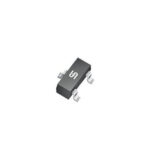 BAV23CH RFG

The activity of extra discounts on wholesale prices is in full swing…
Please fill in your contact information and we will send you the latest wholesale price list.





