 ChipApex | Global Electronic Components Supplier

SEARCH
Search Product
Search Post
— IC芯片 | 连接器 | 传感器 | 被动器件 —
Search productSearch post
— IC芯片 | 连接器 | 传感器 | 被动器件 —
Consult the customer manager about the wholesale price.
consultation hotline:86-132-6715-2157
email:[email protected]
Contact the product manager for consultation. One-stop consultation is available.
Do you want a lower wholesale price? Please send us your inquiry and we will reply immediately.
The Nexperia BAV70,215 is a high-speed switching double diode housed in an SOT-23 (TO-236AB) surface-mount package. It features a reverse voltage rating of up to 100 V and an average rectified current of 215 mA. The device exhibits a low forward voltage drop and minimal capacitance, ensuring efficient signal integrity. Designed for general-purpose applications, it supports a maximum junction temperature of +150 °C and operates within a wide thermal range from -55 °C to +150 °C.
Verify the specific datasheet revision and electrical parameter tolerances against the official Nexperia documentation before integration. Confirm that the SOT-23 package dimensions align with the target PCB footprint. Ensure compliance with RoHS directives and check for any automotive qualification requirements if the application demands AEC-Q101 standards. Validate thermal management capabilities under expected operating conditions.
Select this component when a compact, high-speed diode solution is required for low-voltage signal paths. The SOT-23 package offers space efficiency compared to larger through-hole alternatives. Consider the 100 V reverse voltage rating for standard logic-level protection tasks. Evaluate the low capacitance specification to ensure minimal distortion in high-frequency signal lines where parasitic effects must be minimized.
This part belongs to Nexperia's high-speed switching diode portfolio, designed for modern electronics requiring small form factors. It serves as a common replacement for legacy discrete diodes in consumer and industrial equipment. The SOT-23 variant provides a standardized footprint compatible with automated assembly processes, supporting mass production needs across various electronic device categories.
Cross-reference with BAV70W or BAV70S-Q for alternative package options such as SC-70 or SC-88. Verify pinout compatibility and electrical limits when substituting with generic equivalents. Ensure that any substitute maintains the required switching speed and leakage current specifications for the specific circuit design.
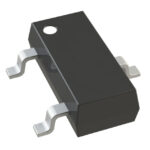 BAV70,215

The activity of extra discounts on wholesale prices is in full swing…
Please fill in your contact information and we will send you the latest wholesale price list.




