 ChipApex | Global Electronic Components Supplier
SEARCH
Search Product
Search Post
— IC芯片 | 连接器 | 传感器 | 被动器件 —
Search productSearch post
— IC芯片 | 连接器 | 传感器 | 被动器件 —
Consult the customer manager about the wholesale price.
consultation hotline:86-132-6715-2157
email:[email protected]
Contact the product manager for consultation. One-stop consultation is available.
Do you want a lower wholesale price? Please send us your inquiry and we will reply immediately.
The BBY40TA is a silicon varactor diode manufactured by Diodes Incorporated, housed in an SOT-23-3 surface-mount package. It is designed for high-frequency tuning applications within electronic circuits. The component supports a maximum operating temperature of +150°C and features a single configuration. Key electrical specifications include a maximum reverse voltage rating of 28V and a power dissipation capacity of 330mW. It provides a minimum tuning ratio of 5, enabling effective capacitance variation for oscillator and filter circuit adjustments.
Verify the specific suffix and marking codes on the physical component to ensure alignment with the BBY40TA designation from Diodes Incorporated. Confirm that the received units match the SOT-23-3 package dimensions and pinout configuration documented in the official datasheet. Ensure compliance with RoHS directives and check for any regional distribution restrictions or supply limitations before finalizing procurement orders.
Select this component when a small-form-factor varactor diode is required for VCO or tuning applications. The SOT-23-3 package offers space efficiency for dense PCB layouts. Consider the 28V reverse voltage limit and 330mW power dissipation rating against the circuit's operational requirements. Ensure the minimum tuning ratio of 5 meets the necessary frequency deviation specifications for the target application.
This part belongs to the category of varactor diodes produced by Diodes Incorporated. It serves as a passive semiconductor device used primarily for its voltage-dependent capacitance properties. Unlike standard rectifier or switching diodes, this component is engineered specifically for reactive circuit elements where capacitance adjustment via applied voltage is critical for signal processing functions.
Consult official manufacturer substitution guides for verified equivalent part numbers. Cross-reference pin configurations, maximum ratings, and capacitance-voltage curves to ensure functional compatibility. Generic substitutes may not match the specific tuning ratio or thermal characteristics of the original component.
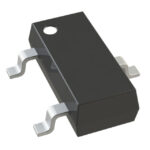 BBY40TA
The activity of extra discounts on wholesale prices is in full swing…
Please fill in your contact information and we will send you the latest wholesale price list.





