 ChipApex | Global Electronic Components Supplier
SEARCH
Search Product
Search Post
— IC芯片 | 连接器 | 传感器 | 被动器件 —
Search productSearch post
— IC芯片 | 连接器 | 传感器 | 被动器件 —
Consult the customer manager about the wholesale price.
consultation hotline:86-132-6715-2157
email:[email protected]
Contact the product manager for consultation. One-stop consultation is available.
Do you want a lower wholesale price? Please send us your inquiry and we will reply immediately.
The BBY6605WE6327HTSA1 is a silicon hyperabrupt tuning diode manufactured by Infineon Technologies, designed for low tuning voltage operation in mobile communications equipment. It features a common cathode configuration within an SOT-323 package with a series inductance of 1.4 nH. The device supports a maximum reverse voltage of 12 V and a forward current of 50 mA. Key electrical characteristics include a capacitance ratio of 5.41 at 1 V to 4.5 V, a typical series resistance of 0.25 Ω at 470 MHz, and a capacitance value of 12 pF at 4.5 V reverse bias. It operates within a temperature range of -55 °C to 150 °C.
Verify component authenticity through official Infineon channels or authorized distributors. Confirm the specific suffix matches the required package and marking specifications. Ensure compliance with RoHS directives as the standard package is lead-free. Request relevant datasheets and quality certificates prior to finalizing orders to validate technical suitability.
Select this component when designing circuits that require precise frequency control with minimal tuning voltage swings. The common cathode configuration simplifies circuit layout compared to single diodes. Consider the 1.4 nH series inductance for high-frequency impedance matching. Verify that the 12 V reverse voltage rating aligns with the peak reverse voltages present in the target application environment.
This part belongs to the BBY66 series of silicon tuning diodes from Infineon Technologies. The series includes variants such as the BBY66-02V and BBY66-05, which differ primarily in package type and internal marking codes. The BBY6605WE6327HTSA1 specifically utilizes the SOT-323 surface-mount package, distinguishing it from the SC79 and SOT23 options available in the broader product family.
Direct substitutes within the same family include the BBY66-05W/G32. Cross-manufacturer replacements must match the 12 V reverse voltage, SOT-323 footprint, and hyperabrupt capacitance-voltage characteristics. Verify that alternative components meet the same AEC-Q101 qualification requirements if used in automotive contexts.
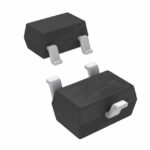 BBY6605WE6327HTSA1
The activity of extra discounts on wholesale prices is in full swing…
Please fill in your contact information and we will send you the latest wholesale price list.





