 ChipApex | Global Electronic Components Supplier
SEARCH
Search Product
Search Post
— IC芯片 | 连接器 | 传感器 | 被动器件 —
Search productSearch post
— IC芯片 | 连接器 | 传感器 | 被动器件 —
Consult the customer manager about the wholesale price.
consultation hotline:86-132-6715-2157
email:[email protected]
Contact the product manager for consultation. One-stop consultation is available.
Do you want a lower wholesale price? Please send us your inquiry and we will reply immediately.
The BC846AW-TP is an NPN general-purpose bipolar junction transistor manufactured by Micro Commercial Components. It features a collector-emitter breakdown voltage of 65 V and a maximum continuous collector current of 100 mA. The device operates with a transition frequency of 100 MHz and has a maximum power dissipation of 150 mW. DC current gain (hFE) is specified at a minimum of 110 under test conditions of 2 mA base current and 5 V collector-emitter voltage. The saturation voltage is limited to 600 mV at 5 mA base current and 100 mA collector current. It utilizes an SOT-323 surface-mount package and supports a junction temperature range from -65°C to 150°C.
Verify the specific suffix 'TP' against the manufacturer's official datasheet to confirm pinout orientation and marking codes, as variations exist within the BC846 family. Ensure the ordering part number matches the required voltage rating (65V) and package type (SOT-323). Cross-reference the RoHS compliance status directly with the latest MCC documentation before finalizing procurement specifications.
Select this component when a 65V NPN transistor in an SOT-323 package is required for space-constrained designs. Compare the 150 mW power dissipation limit against thermal requirements. Verify that the 100 mA collector current meets load demands. Consider the hFE range if precise gain control is necessary for the amplifier stage.
This part belongs to the BC846 series of small-signal NPN transistors produced by Micro Commercial Components. It serves as a surface-mount alternative to larger through-hole packages while maintaining similar electrical performance profiles. The series is designed for general-purpose applications where low cost and small footprint are prioritized alongside standard switching capabilities.
BC846AW-AU (Panjit) offers identical electrical ratings and SOT-323 packaging. BC846BLT3G (ON Semiconductor) provides comparable performance but specifies 225 mW power dissipation. Verify pinout compatibility and marking codes before substituting.
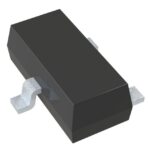 BC846AW-TP
The activity of extra discounts on wholesale prices is in full swing…
Please fill in your contact information and we will send you the latest wholesale price list.





