 ChipApex | Global Electronic Components Supplier
SEARCH
Search Product
Search Post
— IC芯片 | 连接器 | 传感器 | 被动器件 —
Search productSearch post
— IC芯片 | 连接器 | 传感器 | 被动器件 —
Consult the customer manager about the wholesale price.
consultation hotline:86-132-6715-2157
email:[email protected]
Contact the product manager for consultation. One-stop consultation is available.
Do you want a lower wholesale price? Please send us your inquiry and we will reply immediately.
The BC848AMTF is an NPN general-purpose small signal transistor manufactured by Fairchild Semiconductor. It features a collector-emitter voltage (VCEO) of 30 V and a maximum continuous collector current (IC) of 100 mA. The device utilizes a planar epitaxial silicon design suitable for surface-mount applications. It is housed in a SOT-23 package, which provides a compact form factor with three terminals. The component is RoHS compliant and lead-free, ensuring adherence to environmental standards for electronic assembly processes.
Verify the specific manufacturer documentation for the BC848AMTF to confirm exact electrical tolerances and thermal characteristics. Ensure compatibility with standard SOT-23 footprint designs during procurement. Cross-reference datasheets from authorized distributors to validate compliance with current environmental regulations and material specifications before finalizing supply chain agreements.
Select this component for applications requiring a standard NPN small-signal transistor with moderate current handling capabilities. The SOT-23 package is ideal for high-density board designs. Consider the 30 V collector-emitter voltage rating when designing circuits operating within these limits. Verify that the 100 mA current rating aligns with the specific load requirements of the target application circuit.
The BC848 series represents a widely used family of NPN general-purpose transistors. The AMTF suffix typically denotes a specific tape-and-reel packaging variant intended for automated surface-mount assembly. This part belongs to the broader category of small-signal bipolar junction transistors (BJTs) commonly found in analog and digital logic interface circuits across various industrial and consumer electronics sectors.
Compatible substitutes include the BC848A from other manufacturers such as Diodes Incorporated or Panasonic, provided they adhere to the same SOT-23 package and electrical specifications. Verify pinout compatibility and thermal performance metrics when evaluating alternative sources for production continuity.
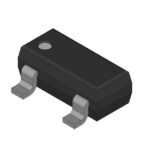 BC848AMTF
The activity of extra discounts on wholesale prices is in full swing…
Please fill in your contact information and we will send you the latest wholesale price list.





