 ChipApex | Global Electronic Components Supplier
SEARCH
Search Product
Search Post
— IC芯片 | 连接器 | 传感器 | 被动器件 —
Search productSearch post
— IC芯片 | 连接器 | 传感器 | 被动器件 —
Consult the customer manager about the wholesale price.
consultation hotline:86-132-6715-2157
email:[email protected]
Contact the product manager for consultation. One-stop consultation is available.
Do you want a lower wholesale price? Please send us your inquiry and we will reply immediately.
The BC849A-AQ is an NPN general-purpose bipolar junction transistor manufactured by Diotec Semiconductor. It utilizes a SOT-23 (TO-236) surface-mount package and operates with a maximum collector current of 100 mA and a peak collector current of 200 mA. The device features a collector-emitter voltage rating of 30 V, a collector-base voltage of 30 V, and an emitter-base voltage of 5 V. Power dissipation reaches 300 mW in industrial and AEC-Q101 grades. The DC current gain (hFE) for Group A ranges from 110 to 220 at 2 mA and 5 V. The transition frequency is 300 MHz, and the operating temperature spans -55°C to +150°C.
Verify that the specific part number includes the -AQ suffix to confirm AEC-Q101 qualification status. Ensure the ordering documentation explicitly references the Diotec Semiconductor datasheet version 2026-06-16 or later to validate the manufacturing specifications. Confirm compliance with RoHS directives and REACH regulations as stated in the official product documentation before finalizing procurement.
Select this component when automotive-grade reliability is required for low-power signal processing or switching tasks. The BC849A-AQ offers a defined hFE range suitable for precise biasing requirements compared to standard commercial variants. Its small SOT-23 footprint allows for dense board layouts while maintaining robust thermal performance up to 150°C junction temperature.
This transistor belongs to the BC846 through BC850 series of SMD general-purpose NPN transistors. The -AQ suffix specifically denotes AEC-Q101 qualification, distinguishing it from standard commercial (-C) or industrial grades. It serves as the NPN counterpart to the BC859A-AQ PNP transistor within the same family.
BC849B-AQ
The BC849A-AQ is AEC-Q101 qualified for automotive applications, whereas the standard BC849A is an industrial grade component without this specific automotive certification.
The BC849A-AQ uses gold bond wires, unlike the commercial grade (-C) variant which utilizes copper bond wires.
The maximum power dissipation is 300 mW when mounted on a printed circuit board with the minimum recommended pad layout.
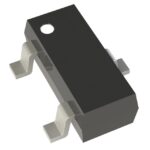 BC849A-AQ
The activity of extra discounts on wholesale prices is in full swing…
Please fill in your contact information and we will send you the latest wholesale price list.





