 ChipApex | Global Electronic Components Supplier
SEARCH
Search Product
Search Post
— IC芯片 | 连接器 | 传感器 | 被动器件 —
Search productSearch post
— IC芯片 | 连接器 | 传感器 | 被动器件 —
Consult the customer manager about the wholesale price.
consultation hotline:86-132-6715-2157
email:[email protected]
Contact the product manager for consultation. One-stop consultation is available.
Do you want a lower wholesale price? Please send us your inquiry and we will reply immediately.
The BCX5516TA is an NPN medium power transistor manufactured by Diodes Incorporated, housed in a surface-mount SOT-89 package. It features a collector-emitter breakdown voltage of 60V and supports a continuous collector current of 1A with a peak pulse capability of 2A. The device utilizes epitaxial planar die construction and offers a low saturation voltage of less than 500mV at 0.5A. Electrical characteristics include a transition frequency of 150MHz and a DC current gain ranging from 75 to 250 depending on the operating current.
Verify the specific ordering suffix '16' corresponds to the required hFE binning range before procurement. Confirm that the SOT-89 tape and reel packaging aligns with automated assembly requirements. Ensure compliance with environmental directives such as RoHS 3 and lead-free definitions if applicable to the target market. Cross-reference the marking code BM with the datasheet to validate authenticity upon receipt.
Select this component when a 60V NPN transistor is required for medium power handling. The BCX5516TA variant provides specific gain binning suitable for consistent amplification performance. Consider thermal management strategies based on the junction-to-ambient resistance values provided in the datasheet. Evaluate the complementary PNP types BCX52 or BCX53 if push-pull configurations are necessary for the design.
This part belongs to the BCX54/55/56 family of NPN medium power transistors designed for general-purpose applications. The BCX55 variant specifically targets 60V operation, distinguishing it from the 45V BCX54 and 80V BCX56 models. The '16' suffix indicates a specific DC current gain classification within the series. These devices share mechanical dimensions and mounting styles across the family.
BCX55TA serves as the standard gain variant replacement. BCX56TA offers higher voltage tolerance but requires verification of circuit compatibility. Complementary PNP transistors BCX52TA or BCX53TA may be used for matched pairs in differential or push-pull topologies.
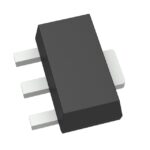 BCX5516TA
The activity of extra discounts on wholesale prices is in full swing…
Please fill in your contact information and we will send you the latest wholesale price list.





