 ChipApex | Global Electronic Components Supplier

SEARCH
Search Product
Search Post
— IC芯片 | 连接器 | 传感器 | 被动器件 —
Search productSearch post
— IC芯片 | 连接器 | 传感器 | 被动器件 —
Consult the customer manager about the wholesale price.
consultation hotline:86-132-6715-2157
email:[email protected]
Contact the product manager for consultation. One-stop consultation is available.
Do you want a lower wholesale price? Please send us your inquiry and we will reply immediately.
The BSS816NW L6327 is an N-channel enhancement mode MOSFET manufactured by Infineon Technologies. It utilizes Si technology and is housed in a SOT-323-3 surface-mount package. Key electrical parameters include a drain-source breakdown voltage of 20 V, a continuous drain current of 1.4 A, and a maximum on-resistance of 107 mOhms at Vgs=10V. The gate-source voltage range is -8 V to +8 V, with a typical threshold voltage of 550 mV. Gate charge is specified at 600 pC. The device supports operation from -55°C to +150°C, features a power dissipation of 500 mW, and includes avalanche rating capability.
Verify the specific suffix L6327 against official Infineon documentation to confirm reel packaging details and marking codes. Ensure compatibility with SOT-323-3 footprint requirements during PCB design. Confirm RoHS compliance status through the manufacturer's latest declaration. Cross-reference datasheet revisions to ensure parameter consistency with current production batches.
Select this component for applications requiring low gate charge and fast switching speeds within a compact SOT-323-3 package. The 20V rating suits low-voltage systems, while the 1.4A current capacity supports moderate load requirements. Consider the 107 mOhm on-resistance for efficiency calculations in power-sensitive designs. Verify thermal management needs given the 500 mW power dissipation limit in the small outline package.
This part belongs to the BSS816 series of OptiMOS2 small-signal transistors. These components are designed for high-frequency switching and compact designs. The series offers low negative turn-off voltage and a wide operating temperature range, reducing design complexity for automotive and industrial applications requiring reliable N-channel enhancement mode performance.
Check for direct pin-compatible alternatives within the same BSS816 family or other SOT-323-3 N-channel MOSFETs with matching 20V/1.4A ratings. Verify that substitute parts meet the same AEC-Q101 qualification if automotive reliability is required. Ensure on-resistance and gate charge specifications remain comparable to maintain circuit timing and efficiency.
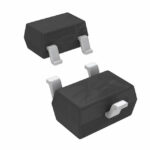 BSS816NW L6327

The activity of extra discounts on wholesale prices is in full swing…
Please fill in your contact information and we will send you the latest wholesale price list.





