ChipApex | Global Electronic Components Supplier

SEARCH
Search Product
Search Post
— IC芯片 | 连接器 | 传感器 | 被动器件 —
Search productSearch post
— IC芯片 | 连接器 | 传感器 | 被动器件 —
Consult the customer manager about the wholesale price.
consultation hotline:86-132-6715-2157
email:[email protected]
Contact the product manager for consultation. One-stop consultation is available.
Do you want a lower wholesale price? Please send us your inquiry and we will reply immediately.
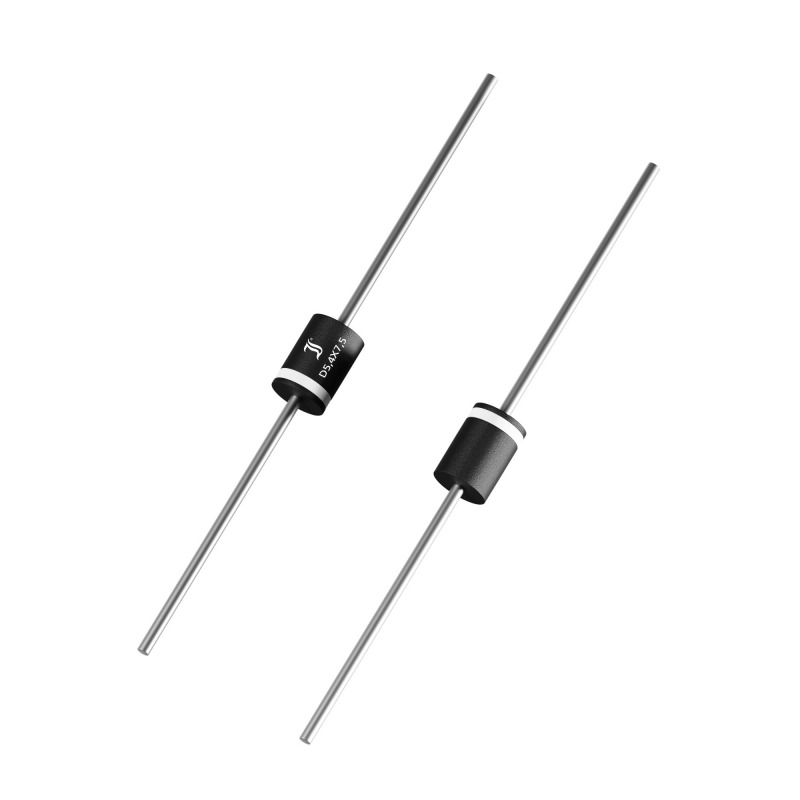
The BY500-1000 is a fast recovery rectifier diode manufactured by Diotec Semiconductor. It features an average forward current (IFAV) of 5 A and a peak forward surge current (IFSM) of 220 A at 60 Hz. The device has a maximum repetitive reverse voltage rating of 1000 V, with a typical junction capacitance of 15 pF at 4 V reverse bias. Forward voltage is less than 1.3 V at 5 A, and leakage current is under 5 µA. Reverse recovery time is less than 200 ns. Thermal resistance from junction to ambient is less than 19 K/W, while junction-to-lead resistance is below 8 K/W. Operating and storage temperatures range from -50°C to +175°C.
Verify the specific suffix code against official Diotec documentation to confirm the exact reverse voltage rating, as the BY500 series covers multiple voltage grades. Confirm RoHS compliance status and packaging options directly with the manufacturer or authorized distributors before ordering. Ensure thermal management design accounts for the specified junction-to-ambient thermal resistance limits under actual operating conditions.
Select this component when a 5 A continuous current rating and high-voltage blocking capability are required in a compact axial package. Consider the low reverse recovery time for efficiency in high-frequency applications. Evaluate thermal derating curves if ambient temperatures exceed standard conditions. Compare junction capacitance requirements against signal integrity needs in sensitive circuits.
This part belongs to the BY500 series of fast recovery rectifiers from Diotec Semiconductor. The series offers various voltage ratings tailored for different power supply designs. These diodes utilize standard axial leaded packaging suitable for through-hole mounting technologies commonly found in legacy and robust industrial equipment designs.
Check datasheets for equivalent 5 A fast recovery diodes with matching voltage ratings and reverse recovery times. Verify pinout compatibility and thermal resistance specifications to ensure direct substitution without circuit redesign.
 BY500-1000

The activity of extra discounts on wholesale prices is in full swing…
Please fill in your contact information and we will send you the latest wholesale price list.