ChipApex | Global Electronic Components Supplier
SEARCH
Search Product
Search Post
— IC芯片 | 连接器 | 传感器 | 被动器件 —
Search productSearch post
— IC芯片 | 连接器 | 传感器 | 被动器件 —
Consult the customer manager about the wholesale price.
consultation hotline:86-132-6715-2157
email:[email protected]
Contact the product manager for consultation. One-stop consultation is available.
Do you want a lower wholesale price? Please send us your inquiry and we will reply immediately.
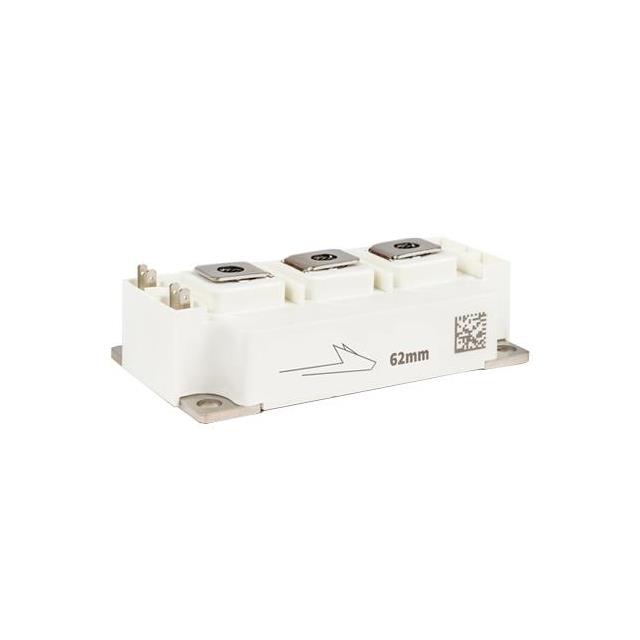
The CAS300M12BM2 is a Silicon Carbide half-bridge module from Wolfspeed, rated for 1200 V and 300 A. It features an industry-standard 62 mm footprint with a copper baseplate and aluminum nitride insulator. Key electrical parameters include a typical drain-source on-state resistance of 5.67 mΩ at 25 °C and a maximum gate-source voltage of +25 V transient or -5/+20 V static. The module supports a virtual junction temperature range of -40 °C to 150 °C, with a continuous drain current capability of 498 A at 25 °C case temperature.
Verify the specific revision status and RoHS compliance documentation directly with Wolfspeed before finalizing procurement plans. Confirm that the ordering suffix matches the required package configuration and thermal interface specifications. Ensure all handling procedures adhere to electrostatic discharge guidelines appropriate for silicon carbide power modules.
Select this component when designing systems requiring high efficiency and compact form factors within the 62 mm module family. Evaluate thermal management requirements based on the specified junction-to-case thermal resistance values. Ensure gate driver capabilities align with the recommended static gate voltage range of -5 V to +20 V for optimal switching performance.
This part belongs to the BM2 generation of Wolfspeed's 62 mm SiC power module portfolio. It serves as a direct mechanical replacement for legacy silicon modules while offering superior electrical performance. The module integrates both MOSFET and Schottky diode functions in a single half-bridge configuration optimized for industrial and traction applications.
Direct pin-compatible replacements within the same 62 mm footprint may include other BM2 or BM3 series variants such as the CAS175M12BM3 or CAS500M12BM2, provided current ratings and thermal characteristics meet the specific application requirements.
The recommended static gate-source voltage range is -5 V to +20 V.
SiC Schottky diodes do not have reverse recovery energy, though they contribute capacitive energy during switching transitions.
The stray inductance is typically 11.1 nH measured at 10 MHz.
 CAS300M12BM2
The activity of extra discounts on wholesale prices is in full swing…
Please fill in your contact information and we will send you the latest wholesale price list.