 ChipApex | Global Electronic Components Supplier
SEARCH
Search Product
Search Post
— IC芯片 | 连接器 | 传感器 | 被动器件 —
Search productSearch post
— IC芯片 | 连接器 | 传感器 | 被动器件 —
Consult the customer manager about the wholesale price.
consultation hotline:86-132-6715-2157
email:[email protected]
Contact the product manager for consultation. One-stop consultation is available.
Do you want a lower wholesale price? Please send us your inquiry and we will reply immediately.
The CGHV40180P is an unmatched gallium nitride (GaN) high electron mobility transistor (HEMT) designed for general-purpose broadband RF and microwave applications. Operating from a 50-volt rail, it delivers up to 2.0 GHz operation with a typical small signal gain of 24 dB at 900 MHz. The device provides 250 W typical output power at 900 MHz with 75% efficiency at PSAT. It features a 150 V drain-source voltage rating and operates within a case temperature range of -40°C to +150°C.
Verify the specific package type 440206 and ensure compatibility with the required thermal management solutions. Confirm that the application circuit design accounts for the absolute maximum ratings, particularly the 150V drain-source voltage and operating junction temperature limits. Check for availability of the CGHV40180P-AMP test board if evaluation is required prior to final deployment.
Select this component for designs requiring high power density and broad frequency coverage up to 2.0 GHz. Ensure the biasing network supports the specified gate threshold and quiescent voltages. Consider the thermal resistance characteristics when designing the heat sinking interface to maintain reliable operation within the specified case temperature range.
This part belongs to MACOM's CGHV series of GaN on Silicon Carbide transistors. It is distinct from the CGHV40180F variant by its package type and specific electrical characterization. The device is engineered to provide industry-leading gain and efficiency for demanding RF power applications.
Consult official documentation for direct substitutes. The CGHV40180F is a related model but differs in packaging and potentially in detailed electrical parameters; verify compatibility before substitution.
The absolute maximum drain-source voltage (VDSS) rating is 150 Volts at a case temperature of 25 °C.
When operating at low frequencies, a series resistor should be used to maintain amplifier stability.
The typical output power at 900 MHz is 250 Watts when measured in the application circuit.
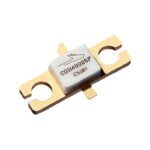 CGHV40180P
The activity of extra discounts on wholesale prices is in full swing…
Please fill in your contact information and we will send you the latest wholesale price list.





