 ChipApex | Global Electronic Components Supplier
SEARCH
Search Product
Search Post
— IC芯片 | 连接器 | 传感器 | 被动器件 —
Search productSearch post
— IC芯片 | 连接器 | 传感器 | 被动器件 —
Consult the customer manager about the wholesale price.
consultation hotline:86-132-6715-2157
email:[email protected]
Contact the product manager for consultation. One-stop consultation is available.
Do you want a lower wholesale price? Please send us your inquiry and we will reply immediately.
The DMC3732UVTQ-13 is a complementary pair enhancement mode MOSFET manufactured by Diodes Incorporated. It integrates an N-channel device (Q1) and a P-channel device (Q2) within a single TSOT26 package. The Q1 channel provides a drain-source voltage of 30V with a maximum continuous drain current of 1.1A at +25°C, while the Q2 channel offers -30V breakdown and -0.7A current capability. Both channels are optimized for low on-state resistance and fast switching speeds, making them suitable for high-efficiency power management applications.
Verify the specific ordering suffix when purchasing. The -13 suffix indicates a tape and reel packaging quantity of 10,000 units. Confirm that the required component matches this exact packing configuration before placing orders to ensure compatibility with automated assembly equipment.
Select this component for designs requiring a matched complementary MOSFET pair in a minimal footprint. Ensure the application operates within the specified thermal limits, as the TSOT26 package has a junction-to-ambient thermal resistance of 230 °C/W on a minimum recommended pad layout. Verify gate drive voltages align with the threshold characteristics for optimal RDS(ON) performance.
This part belongs to the DMC3732 series of complementary MOSFETs from Diodes Incorporated. It is designed to replace discrete N-channel and P-channel solutions, saving board space and simplifying assembly. The device is specifically engineered for portable and consumer electronics where efficiency and size are critical constraints.
Direct replacements must match the TSOT26 package, 30V/30V voltage ratings, and complementary configuration. Verify that alternative components meet the same AEC-Q101 qualification if automotive reliability is required. Check pinout compatibility to ensure correct source, drain, and gate connections.
The maximum continuous gate-source voltage (VGSS) for both the N-channel and P-channel devices is ±8V.
Yes, the device is AEC-Q101 qualified and manufactured in IATF 16949 certified facilities, making it suitable for automotive applications requiring specific change control.
The on-resistance increases as the junction temperature rises. For example, the N-channel RDS(ON) is specified at +25°C but will increase at higher temperatures like +125°C or +150°C, as shown in the typical curves.
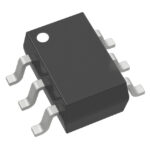 DMC3732UVTQ-13
The activity of extra discounts on wholesale prices is in full swing…
Please fill in your contact information and we will send you the latest wholesale price list.





