 ChipApex | Global Electronic Components Supplier

SEARCH
Search Product
Search Post
— IC芯片 | 连接器 | 传感器 | 被动器件 —
Search productSearch post
— IC芯片 | 连接器 | 传感器 | 被动器件 —
Consult the customer manager about the wholesale price.
consultation hotline:86-132-6715-2157
email:[email protected]
Contact the product manager for consultation. One-stop consultation is available.
Do you want a lower wholesale price? Please send us your inquiry and we will reply immediately.
The DMN61D9UW-13 is a single N-channel enhancement mode MOSFET manufactured by Diodes Incorporated. It features a 60V drain-source breakdown voltage and a continuous drain current of 340mA at 25°C. The device operates with a gate-source voltage range of -20V to +20V and exhibits a maximum on-resistance of 1.2 Ohms at 5V gate drive. Key switching parameters include a gate charge of 400pC, an input capacitance of 28.5pF, and rise/fall times of 1.8ns and 8.4ns respectively. It is housed in an SOT-323-3 surface-mount package with a power dissipation rating of 440mW and a junction temperature range of -55°C to +150°C.
Verify the specific suffix 'W-13' against official Diodes Incorporated documentation to confirm packaging details and compliance status. Confirm availability status as distribution channels may indicate limited supply or end-of-life phases. Ensure the ordering part number matches the exact electrical specifications required for the target application before finalizing procurement orders.
Select this component when a single N-channel MOSFET with 60V rating and SOT-323 footprint is required. Compare on-resistance and gate charge values against alternative parts to ensure compatibility with existing driver circuits. Verify that the 340mA continuous current rating meets the peak and steady-state load requirements of the specific application design.
This component belongs to the DMN61 series of N-channel MOSFETs from Diodes Incorporated. The series typically offers various configurations including dual-channel options and different package types such as SOT-363. The DMN61D9UW-13 specifically represents the single-channel variant in the small SOT-323 package, providing a balance between performance and board space efficiency for portable applications.
Check for direct substitutes within the DMN61 family, such as DMN61D9UDW-7 for dual-channel needs or DMN61D9UWQ-13 for automotive-grade variants. Verify pinout compatibility and electrical parameter equivalence before substituting.
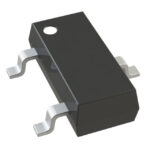 DMN61D9UW-13

The activity of extra discounts on wholesale prices is in full swing…
Please fill in your contact information and we will send you the latest wholesale price list.





