 ChipApex | Global Electronic Components Supplier
SEARCH
Search Product
Search Post
— IC芯片 | 连接器 | 传感器 | 被动器件 —
Search productSearch post
— IC芯片 | 连接器 | 传感器 | 被动器件 —
Consult the customer manager about the wholesale price.
consultation hotline:86-132-6715-2157
email:[email protected]
Contact the product manager for consultation. One-stop consultation is available.
Do you want a lower wholesale price? Please send us your inquiry and we will reply immediately.
The DMTH10H015LK3-13 is a surface-mount N-channel enhancement mode MOSFET manufactured by Diodes Incorporated. It features a maximum drain-source voltage of 100V and a continuous drain current of 52.5A at a case temperature of +25°C. The device exhibits a maximum on-resistance of 15mΩ at VGS=10V and 20A, or 18mΩ at VGS=6V and 20A. Total power dissipation is rated at 2.1W in ambient conditions and 3.5W with a copper plate mount. Thermal resistance from junction to case is 2°C/W. Operating and storage temperatures range from -55°C to +175°C.
Verify the specific ordering suffix '-13' corresponds to the tape and reel packaging configuration containing 2,500 units per reel. Confirm that the component meets RoHS directives and is halogen and antimony free as defined by the manufacturer's green product standards. Ensure the application environment supports the specified thermal characteristics and package type.
Select this component when a 100V N-channel MOSFET with low on-resistance is required for efficient power management. Consider the TO-252 (DPAK) package constraints regarding thermal dissipation and PCB layout. Evaluate the gate threshold voltage requirements against the driver circuit capabilities, noting the variation across different operating temperatures.
This part belongs to the DMTH10H series of N-channel enhancement mode MOSFETs designed for high efficiency applications. It utilizes a TO-252 (DPAK) case constructed with molded plastic and matte tin annealed terminals over a copper leadframe. The device is moisture sensitive at Level 1 per J-STD-020 standards.
The automotive-compliant variant DMTH10H015LK3Q is available under a separate datasheet. Verify pinout compatibility and electrical specifications before substituting with other 100V N-channel MOSFETs in the TO-252 package.
The maximum continuous drain current is 52.5A at a case temperature of +25°C and 37.1A at a case temperature of +100°C.
Yes, the device is qualified to AEC-Q101 standards for high reliability.
The steady-state thermal resistance from junction to case is 2°C/W.
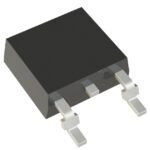 DMTH10H015LK3-13
The activity of extra discounts on wholesale prices is in full swing…
Please fill in your contact information and we will send you the latest wholesale price list.





