 ChipApex | Global Electronic Components Supplier
SEARCH
Search Product
Search Post
— IC芯片 | 连接器 | 传感器 | 被动器件 —
Search productSearch post
— IC芯片 | 连接器 | 传感器 | 被动器件 —
Consult the customer manager about the wholesale price.
consultation hotline:86-132-6715-2157
email:[email protected]
Contact the product manager for consultation. One-stop consultation is available.
Do you want a lower wholesale price? Please send us your inquiry and we will reply immediately.
The DS1080CLU+T is a low-jitter, crystal-based clock generator featuring an integrated phase-locked loop (PLL) to produce spread-spectrum clock outputs ranging from 8MHz to 64MHz. It operates on a single 3.0V to 3.6V supply and supports -40°C to +125°C temperatures. The device allows pin-programmable selection of clock multiplier rates (1x, 2x, 4x) and dither magnitudes (±0.5%, ±1.0%, ±1.5%). It includes power-down and spread-spectrum disable modes for power conservation. The component is housed in an 8-pin µSOP package.
Verify the 'T' suffix indicates tape-and-reel packaging as defined in the datasheet ordering information. Confirm the component meets RoHS standards indicated by the '+' designation. Ensure the specific lot matches the automotive or industrial temperature range requirements if applicable, though this part is rated for -40°C to +125°C.
Select this component when a low-cost, low-jitter solution is required for generating spread-spectrum clocks from a crystal input. It is suitable for applications needing fixed multiplier ratios without external programming interfaces. Ensure the input frequency falls within the 8MHz to 16MHz range for proper PLL operation.
The DS1080CL belongs to Maxim Integrated's EconOscillator family of spread-spectrum clock generators. The 'LU+' designation indicates a lead-free, non-automotive qualified version in an 8-pin µSOP package. The 'T' suffix specifically denotes the tape-and-reel packaging format for automated assembly.
Datasheet does not list direct replacement part numbers. Consider the DS1080LU+ for similar functionality in a different package or the DS1086LU+ for higher frequency spread-spectrum generation capabilities.
The PDN pin controls Power-Down and Spread-Spectrum Disable modes. Logic Low enables power-down with high-impedance output; Open disables spread spectrum but keeps the output active; Logic High enables both power-up and spread spectrum.
The dither rate is fixed at f_IN/512, where f_IN is the input crystal or clock frequency. This design keeps the dither rate above the audio frequency range.
Yes, an 8MHz to 16MHz clock can be applied to the X1 input. In this configuration, the X2 pin should be left open circuit.
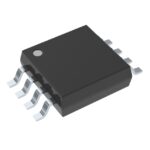 DS1080CLU+T
The activity of extra discounts on wholesale prices is in full swing…
Please fill in your contact information and we will send you the latest wholesale price list.





