 ChipApex | Global Electronic Components Supplier

SEARCH
Search Product
Search Post
— IC芯片 | 连接器 | 传感器 | 被动器件 —
Search productSearch post
— IC芯片 | 连接器 | 传感器 | 被动器件 —
Consult the customer manager about the wholesale price.
consultation hotline:86-132-6715-2157
email:[email protected]
Contact the product manager for consultation. One-stop consultation is available.
Do you want a lower wholesale price? Please send us your inquiry and we will reply immediately.
The GBU25H08-M3/P is a single in-line bridge rectifier manufactured by Vishay General Semiconductor. It features an 800 V maximum repetitive peak reverse voltage and supports a 25 A average forward rectified output current at a case temperature of 125 °C. The device utilizes glass passivated chip junctions and operates within a junction temperature range of -55 to +175 °C. Electrical characteristics include a maximum instantaneous forward voltage drop of 1.05 V at 12.5 A and 25 °C, with a typical reverse recovery time of 3500 ns. The component is housed in a GBU package with matte tin-plated leads.
Verify the specific ordering suffix against official documentation to confirm compliance attributes such as halogen-free status and lead finish. Confirm that the tube packaging aligns with assembly requirements. Ensure technical parameters match the application constraints before finalizing procurement decisions.
Select this component based on the required 800 V blocking voltage and 25 A continuous current capacity. Evaluate thermal management needs, as the average forward current derates significantly when operating without a heatsink. Verify that the GBU package dimensions fit the printed circuit board layout and mounting torque specifications.
This component belongs to the GBU series of single in-line bridge rectifiers from Vishay. The M3 suffix indicates compliance with RoHS directives and JESD 201 class 1A whisker testing standards. The P suffix designates the tube delivery mode for the GBU package style.
Cross-reference with other Vishay GBU series variants or equivalent bridge rectifiers offering matching 800 V and 25 A ratings. Verify pinout compatibility and physical footprint alignment before substitution.
The device supports a non-repetitive peak forward surge current of 350 A for an 8.3 ms single sine-wave and 700 A for a 1.0 ms single sine-wave.
The maximum instantaneous forward voltage drop is 1.05 V at 25 °C and decreases to 0.86 V at 125 °C when conducting 12.5 A.
The typical thermal resistance from junction to ambient is 24 °C/W, while the junction-to-case thermal resistance is 4 °C/W.
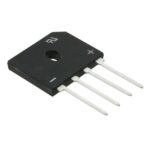 GBU25H08-M3/P

The activity of extra discounts on wholesale prices is in full swing…
Please fill in your contact information and we will send you the latest wholesale price list.






