ChipApex | Global Electronic Components Supplier

SEARCH
Search Product
Search Post
— IC芯片 | 连接器 | 传感器 | 被动器件 —
Search productSearch post
— IC芯片 | 连接器 | 传感器 | 被动器件 —
Consult the customer manager about the wholesale price.
consultation hotline:86-132-6715-2157
email:[email protected]
Contact the product manager for consultation. One-stop consultation is available.
Do you want a lower wholesale price? Please send us your inquiry and we will reply immediately.
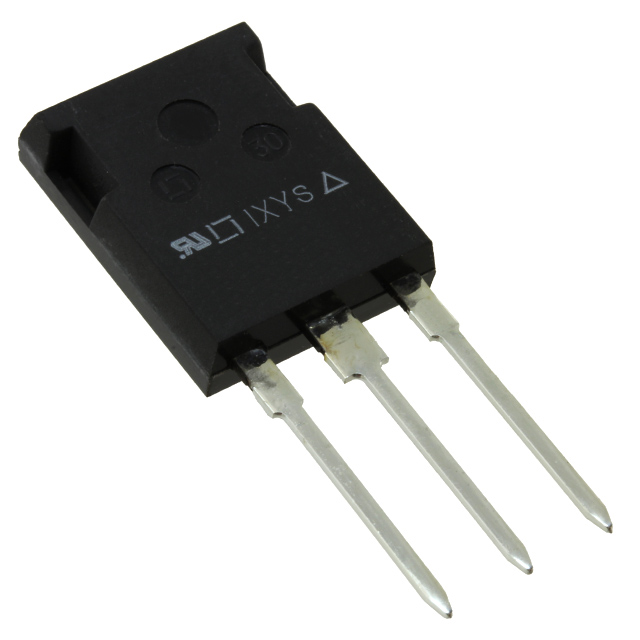
The IXDR30N120 is a high-voltage NPT IGBT with an integrated fast recovery epitaxial diode (FRED) in the ISOPLUS247 package. It features a collector-emitter voltage of 1200 V and a continuous collector current of 50 A at 25°C, dropping to 30 A at 90°C. The device exhibits a typical saturation voltage of 2.4 V at 30 A and supports a short-circuit withstand time of 10 µs. Thermal resistance from junction to case is 0.6 K/W for the IGBT and 1.3 K/W for the diode. Operating temperatures range from -55°C to +150°C.
Verify component authenticity through authorized Littelfuse or IXYS distributors. Confirm datasheet revision status as specifications may be updated. Ensure storage conditions maintain moisture sensitivity levels appropriate for surface mount assembly processes. Validate that the specific ordering suffix matches the required isolation and packaging configuration for your design.
Select this component for applications requiring high voltage blocking capability and robust short-circuit tolerance. The ISOPLUS247 package facilitates clip or spring mounting for improved thermal performance. Consider the 10 µs short circuit capability when designing protection circuits. Evaluate the integrated FRED characteristics if synchronous rectification or freewheeling functions are needed within the same package footprint.
This part belongs to the IXDR series of high-power IGBT modules manufactured by IXYS, now part of Littelfuse. The ISOPLUS247 package provides electrical isolation between the collector tab and the leads, distinguishing it from standard TO-247 packages. It is designed for high-density power electronics where space savings and high power density are critical requirements.
Direct replacements must match the 1200 V rating, 50 A current capacity, and ISOPLUS247 package outline. Verify pinout compatibility and thermal resistance values. Cross-reference with other IXYS IXDR series variants or equivalent NPT IGBTs from other manufacturers ensuring identical gate drive requirements and switching energy profiles.
 IXDR30N120

The activity of extra discounts on wholesale prices is in full swing…
Please fill in your contact information and we will send you the latest wholesale price list.