ChipApex | Global Electronic Components Supplier
SEARCH
Search Product
Search Post
— IC芯片 | 连接器 | 传感器 | 被动器件 —
Search productSearch post
— IC芯片 | 连接器 | 传感器 | 被动器件 —
Consult the customer manager about the wholesale price.
consultation hotline:86-132-6715-2157
email:[email protected]
Contact the product manager for consultation. One-stop consultation is available.
Do you want a lower wholesale price? Please send us your inquiry and we will reply immediately.
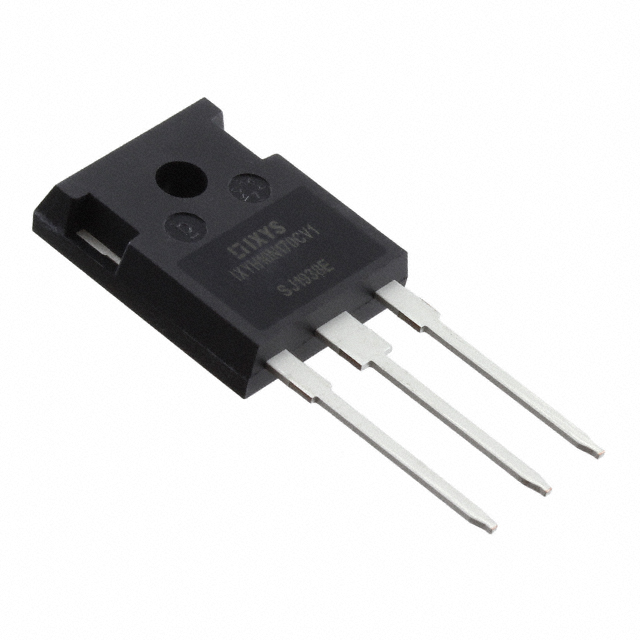
The IXYS IXYH24N170CV1 is a single N-channel Insulated Gate Bipolar Transistor (IGBT) utilizing XPT technology. It features a collector-emitter voltage rating of 1700 V and a continuous collector current of 58 A at 25°C. The device operates in a TO-247-3 through-hole package with a maximum power dissipation of 500 W. It supports a junction temperature range from -55°C to +175°C, offering robust thermal performance for high-voltage switching applications.
Verify the specific suffix CV1 against the manufacturer's latest datasheet to confirm pinout compatibility and electrical characteristics. Ensure that the TO-247-3 package dimensions match the target PCB footprint requirements. Cross-reference RoHS compliance status with current regulatory standards before finalizing component selection for production.
Select this component when a 1700 V blocking capability is required alongside moderate current handling up to 58 A. The XPT technology makes it suitable for applications prioritizing lower switching losses compared to standard field-stop IGBTs. Consider the 500 W power dissipation limit and ensure adequate heatsinking to maintain junction temperatures within the specified operational range during continuous duty cycles.
This part belongs to IXYS' high-voltage IGBT portfolio, specifically leveraging XPT (eXtended Plate Technology). It serves as a discrete alternative to modules in medium-power applications. The TO-247-3 package provides a balance between thermal performance and mounting simplicity, distinguishing it from surface-mount or module-based solutions in the same voltage class.
Direct substitutes include the IXYH24N170 without the CV1 suffix if electrical parameters are identical. Verify pin compatibility with other 1700V/24A-class IGBTs from IXYS or competitors like Infineon or Mitsubishi, ensuring Vceo and Ic ratings meet or exceed original specifications.
The maximum operating junction temperature is +175°C.
Yes, it utilizes IXYS' XPT (eXtended Plate Technology) to optimize switching performance and conduction losses.
 IXYH24N170CV1
The activity of extra discounts on wholesale prices is in full swing…
Please fill in your contact information and we will send you the latest wholesale price list.