 ChipApex | Global Electronic Components Supplier
SEARCH
Search Product
Search Post
— IC芯片 | 连接器 | 传感器 | 被动器件 —
Search productSearch post
— IC芯片 | 连接器 | 传感器 | 被动器件 —
Consult the customer manager about the wholesale price.
consultation hotline:86-132-6715-2157
email:[email protected]
Contact the product manager for consultation. One-stop consultation is available.
Do you want a lower wholesale price? Please send us your inquiry and we will reply immediately.
The IXYN200N65B5 is a 650 V, 200 A Gen5 XPT™ Insulated Gate Bipolar Transistor manufactured by IXYS. It utilizes Extreme Light Punch Through technology and a Trench IGBT process to achieve reduced thermal resistance and high power density. The device features an SOT-227B package with isolated baseplate construction. Key electrical parameters include a collector-emitter saturation voltage of 1.45 V at 100 A, a continuous collector current of 390 A at 25°C, and a maximum junction temperature of 175°C. Designed for medium switching applications between 5 kHz and 30 kHz, it offers a square Reverse Biased Safe Operating Area (RBSOA) and positive thermal coefficient characteristics.
Verify the component authenticity through Littelfuse or authorized IXYS distributors. Confirm the specific ordering suffix matches the required package variant. Ensure the procurement channel provides valid traceability documentation. Check for RoHS compliance status if environmental regulations apply to the final assembly. Validate that the received part number corresponds exactly to the design specifications.
Select this component for designs requiring high current handling up to 200 A at elevated temperatures. The SOT-227B package is suitable for screw-mount applications on heat sinks. Consider the 0.125 °C/W junction-to-case thermal resistance for thermal management calculations. Ensure the gate drive voltage supports the specified 15 V operating level for optimal performance. Verify that the switching frequency falls within the 5–30 kHz range for best efficiency.
This device belongs to the IXYS Gen5 XPT™ family of IGBTs. It represents an evolution in thin-wafer technology designed to lower conduction losses while maintaining high blocking voltage capabilities. The product line targets industrial power conversion systems where reliability and power density are critical constraints.
Direct replacements must match the 650 V rating, 200 A current capacity, and SOT-227B footprint. Verify pinout compatibility, specifically the isolated baseplate configuration. Compare thermal resistance values to ensure equivalent heat dissipation performance. Check dynamic parameters like turn-off energy to maintain system switching behavior.
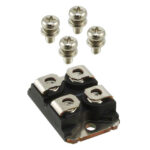 IXYN200N65B5
The activity of extra discounts on wholesale prices is in full swing…
Please fill in your contact information and we will send you the latest wholesale price list.





