 ChipApex | Global Electronic Components Supplier

SEARCH
Search Product
Search Post
— IC芯片 | 连接器 | 传感器 | 被动器件 —
Search productSearch post
— IC芯片 | 连接器 | 传感器 | 被动器件 —
Consult the customer manager about the wholesale price.
consultation hotline:86-132-6715-2157
email:[email protected]
Contact the product manager for consultation. One-stop consultation is available.
Do you want a lower wholesale price? Please send us your inquiry and we will reply immediately.
The MDD KBU1010 is a through-hole silicon bridge rectifier from the KBU series, featuring a molded plastic body and four solder-plated leads. It supports a maximum repetitive peak reverse voltage of 1000V and an average forward output rectified current of 10A at 50°C case temperature. The device exhibits a typical forward voltage drop of 1.0V at 5.0A and handles a peak forward surge current of 240A for 8.3ms. Operating junction temperatures range from -55°C to +150°C, with storage temperatures matching this span. The component complies with RoHS/RoHS III standards and carries Underwriter Laboratory Flammability Classification 94V-0.
Verify the original part number matches MDD KBU1010 and confirm the package code indicates bulk packaging containing 400 pieces per box. Ensure the specification code aligns with the 1000V reverse voltage and 10A forward current ratings. Check for RoHS/RoHS III compliance documentation and confirm the flammability classification meets 94V-0 requirements before finalizing procurement orders.
Select this component when a 1000V blocking voltage and 10A continuous current are required in a through-hole configuration. Consider the 240A surge capability for inrush protection scenarios. Verify thermal management needs against the 10A rating at 50°C case temperature. Ensure PCB layout accommodates the KBU package dimensions and lead spacing for reliable mechanical attachment.
The KBU1010 belongs to the KBU series of through-hole silicon bridge rectifiers manufactured by MDD. This series utilizes a molded plastic body designed for robust mechanical performance. The component is marked with 'KBU1010' on the casing. It is distinct from surface mount variants and offers high reliability for industrial and commercial power applications requiring standard axial lead mounting.
Cross-reference parts must match the 1000V reverse voltage, 10A forward current, and KBU through-hole package. Verify equivalent thermal resistance and surge current capabilities. Confirm polarity marking orientation remains consistent to prevent installation errors in existing designs.
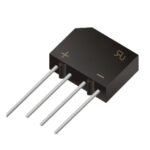 KBU1010

The activity of extra discounts on wholesale prices is in full swing…
Please fill in your contact information and we will send you the latest wholesale price list.






