 ChipApex | Global Electronic Components Supplier
SEARCH
Search Product
Search Post
— IC芯片 | 连接器 | 传感器 | 被动器件 —
Search productSearch post
— IC芯片 | 连接器 | 传感器 | 被动器件 —
Consult the customer manager about the wholesale price.
consultation hotline:86-132-6715-2157
email:[email protected]
Contact the product manager for consultation. One-stop consultation is available.
Do you want a lower wholesale price? Please send us your inquiry and we will reply immediately.
The KSC1674CYBU is an NPN epitaxial silicon RF bipolar junction transistor manufactured by Fairchild Semiconductor. It is housed in a TO-92-3 (TO-226AA) through-hole package. The device features a maximum collector-emitter breakdown voltage of 20V and a maximum continuous collector current of 20mA. It has a transition frequency of 600MHz and a maximum power dissipation of 250mW. The DC current gain (hFE) is specified with a minimum value of 70 at 1mA and 6V. The component operates within a junction temperature range up to 150°C.
Verify the manufacturer designation carefully, as the KSC1674 series has been produced by multiple entities including Fairchild Semiconductor and onsemi. Confirm the specific datasheet version and electrical test conditions match the design requirements. Check for RoHS compliance status and lead-free certification if required by the assembly process. Ensure the TO-92-3 pinout configuration aligns with the PCB footprint layout before finalizing procurement.
Select this component when an NPN RF transistor with a 20V VCEO rating and 600MHz transition frequency is required. The 20mA collector current limit and 250mW power dissipation define the operational boundaries. Compare the hFE minimum of 70 against circuit gain requirements. Consider the TO-92-3 package constraints for thermal management and mechanical integration in through-hole designs.
The KSC1674 series belongs to the family of small-signal RF bipolar transistors designed for high-frequency operations. Variants such as KSC1674COBU and KSC1674OTA share similar electrical characteristics but may differ in packaging suffixes or manufacturing lots. The part is categorized under discrete semiconductors, specifically bipolar RF transistors, intended for consumer and communication electronics requiring low-noise amplification.
Publicly confirmed substitute part numbers are not available in the provided source data. Cross-reference with other NPN RF transistors having comparable VCEO, IC, and fT specifications only after verifying detailed parameter alignment.
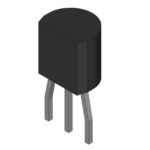 KSC1674CYBU
The activity of extra discounts on wholesale prices is in full swing…
Please fill in your contact information and we will send you the latest wholesale price list.





