 ChipApex | Global Electronic Components Supplier

SEARCH
Search Product
Search Post
Search productSearch post
Consult the customer manager about the wholesale price.
consultation hotline:86-132-6715-2157
email:[email protected]
Contact the product manager for consultation. One-stop consultation is available.
Do you want a lower wholesale price? Please send us your inquiry and we will reply immediately.
KSD2058YTU is listed in the Single Bipolar Transistors range at ChipApex. The manufacturer field lists onsemi. Its product description is TRANS NPN 60V 3A TO-220F-3. Review the specifications below when checking this part for your BOM.
The KSD2058YTU is an NPN epitaxial silicon transistor manufactured by onsemi, formerly Fairchild Semiconductor. It features a collector-emitter voltage of 60 V and a continuous collector current rating of 3 A at 25°C case temperature. The device provides a DC current gain (hFE) ranging from 60 to 300 depending on the classification suffix. Key electrical parameters include a maximum collector dissipation of 1.5 W at ambient temperature and 25 W at case temperature. The transistor operates within a junction temperature range of -55°C to 150°C and utilizes a TO-220F package.
Verify the specific hFE classification suffix (O, Y, or G) required for your design, as this determines the minimum and maximum current gain values. Confirm that the TO-220F package dimensions match your PCB footprint requirements. Ensure thermal management strategies account for the 1.5 W ambient dissipation limit if a heat sink is not utilized. Check for updated manufacturer documentation as product status may have changed since the original datasheet release.
Select the appropriate hFE bin based on the required gain stability for the amplifier stage. Consider the thermal resistance characteristics when designing for high ambient temperatures. Evaluate the saturation voltage at the intended operating current to ensure efficient switching performance. Verify that the collector-base and emitter-base voltage ratings exceed the maximum transient voltages present in the circuit.
This component belongs to the family of NPN power transistors designed for general-purpose amplification and switching. It was originally produced by Fairchild Semiconductor International before the brand transitioned to onsemi. The TO-220F package offers a balance of thermal performance and mounting convenience for through-hole assembly.
Public confirmed substitute part numbers are not available in the provided source material.
Explore related parts through Bipolar (BJT), Transistors, Discrete Semiconductor Products, all product categories.
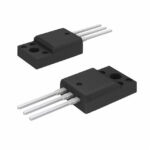 KSD2058YTU

The activity of extra discounts on wholesale prices is in full swing…
Please fill in your contact information and we will send you the latest wholesale price list.





