ChipApex | Global Electronic Components Supplier

SEARCH
Search Product
Search Post
— IC芯片 | 连接器 | 传感器 | 被动器件 —
Search productSearch post
— IC芯片 | 连接器 | 传感器 | 被动器件 —
Consult the customer manager about the wholesale price.
consultation hotline:86-132-6715-2157
email:[email protected]
Contact the product manager for consultation. One-stop consultation is available.
Do you want a lower wholesale price? Please send us your inquiry and we will reply immediately.
The LF444CM is a quad low-power JFET input operational amplifier manufactured by Texas Instruments. It features four independent amplifiers in a single package, offering a gain-bandwidth product of 1 MHz and a slew rate of 1 V/us. The device operates with a supply voltage range of 6 V to 36 V (single) or 3 V to 18 V (dual). Key electrical specifications include an input bias current of 100 pA, input offset voltage of 10 mV, and input noise current density of 10 fA. It consumes 600 uA of operating current per channel and provides 14 mA output current. The common-mode rejection ratio is 95 dB, with input voltage noise density at 35 nV/sqrt Hz. It functions within a temperature range of 0 C to +70 C and is housed in an SOIC-14 surface-mount package.
Verify the specific suffix requirements for the requested part number against official Texas Instruments documentation. Ensure the ordering code matches the exact package type and temperature grade specified in the design. Confirm RoHS compliance status through the manufacturer's latest datasheet. Cross-reference the component marking with the official package outline drawing to prevent counterfeit substitution during assembly.
Select this component when multiple low-noise, high-input-impedance amplifiers are required in a compact surface-mount form factor. The JFET input stage offers superior bias current performance compared to bipolar alternatives. Consider the 1 MHz bandwidth limit for high-frequency applications. Evaluate the SOIC-14 thermal dissipation capabilities for dense PCB layouts. Verify that the 10 mV offset voltage meets the precision requirements of the target circuit.
The LF444CM belongs to the LF444 series of quad operational amplifiers from Texas Instruments. This series is designed as a cost-effective solution for multi-channel analog applications requiring JFET inputs. It serves as a quad variant within the broader LFxx family, sharing core architectural similarities with dual-channel counterparts like the LF442. The component represents a standard industry choice for general-purpose analog interfacing tasks.
Consult official Texas Instruments substitution guides for verified equivalents. Check for pin-compatible alternatives within the same family or newer generations. Verify that any substitute maintains the JFET input topology and similar electrical parameters.
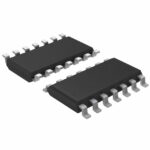 LF444CM

The activity of extra discounts on wholesale prices is in full swing…
Please fill in your contact information and we will send you the latest wholesale price list.