ChipApex | Global Electronic Components Supplier
SEARCH
Search Product
Search Post
— IC芯片 | 连接器 | 传感器 | 被动器件 —
Search productSearch post
— IC芯片 | 连接器 | 传感器 | 被动器件 —
Consult the customer manager about the wholesale price.
consultation hotline:86-132-6715-2157
email:[email protected]
Contact the product manager for consultation. One-stop consultation is available.
Do you want a lower wholesale price? Please send us your inquiry and we will reply immediately.
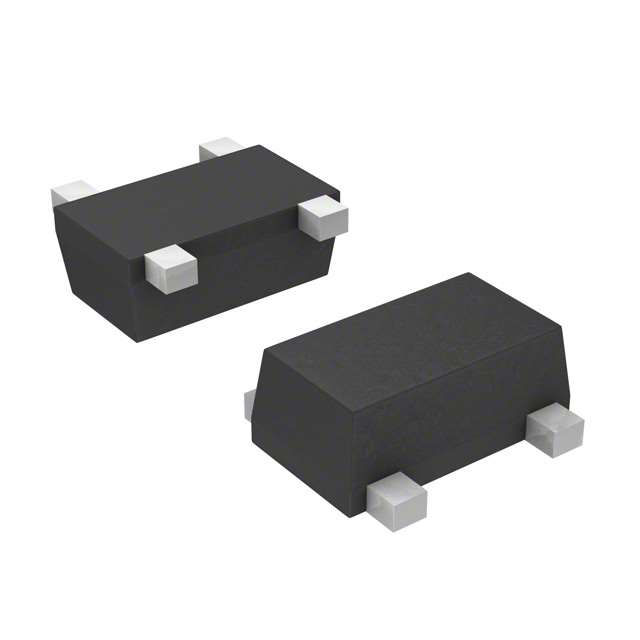
The MCH4021-TL-H is an NPN single RF transistor manufactured by onsemi, designed for high-frequency applications. It features a collector-to-emitter voltage (VCEO) of 8 V and a maximum collector current (IC) of 150 mA. The device achieves a typical gain-bandwidth product (fT) of 16 GHz at VCE=5V and IC=50mA. Forward transfer gain |S21e|^2 reaches 17.5 dB typically at 1 GHz with VCE=5V and IC=50mA. Noise figure (NF) is specified as 1.2 dB typically at f=1 GHz under VCE=1V and IC=10mA conditions. The component utilizes the MCPH4 surface-mount package.
Verify the exact ordering suffix against official manufacturer documentation to ensure correct packaging and handling specifications. Confirm that the MCPH4 package dimensions align with your PCB footprint requirements. Check for static sensitivity warnings during assembly due to the high-frequency process adopted. Ensure compliance with RoHS directives if applicable to your manufacturing standards.
Select this component when designing circuits that require an NPN RF transistor with an 8 V collector-to-emitter rating and high-speed operation up to 16 GHz. Consider the MCPH4 package size for space-constrained designs. Evaluate the noise figure and gain characteristics at your specific operating bias points using the provided S-parameter tables. Ensure thermal management supports the 400 mW dissipation limit.
This part belongs to the MCH series of RF transistors from onsemi, specifically engineered for high-frequency analog and RF applications. The MCPH4 package provides a compact form factor suitable for surface-mount technology. The device is distinct from power MOSFETs or logic-level transistors, focusing instead on RF performance metrics like gain-bandwidth product and noise figure.
Consult onsemi's official replacement guide or distributor databases for direct cross-references. Verify pinout compatibility and electrical parameters such as VCEO, IC, and fT before substitution. Ensure any alternative component meets the same MCPH4 package constraints and RF performance requirements.
 MCH4021-TL-H
The activity of extra discounts on wholesale prices is in full swing…
Please fill in your contact information and we will send you the latest wholesale price list.