 ChipApex | Global Electronic Components Supplier

SEARCH
Search Product
Search Post
— IC芯片 | 连接器 | 传感器 | 被动器件 —
Search productSearch post
— IC芯片 | 连接器 | 传感器 | 被动器件 —
Consult the customer manager about the wholesale price.
consultation hotline:86-132-6715-2157
email:[email protected]
Contact the product manager for consultation. One-stop consultation is available.
Do you want a lower wholesale price? Please send us your inquiry and we will reply immediately.
The MMBD2838LT1G is a dual common-cathode switching diode manufactured by onsemi in a surface-mount SOT-23 package. It features two individual chips within a single three-pin configuration, designed for high-speed signal processing and rectification tasks. The device supports a maximum repetitive peak reverse voltage of 75V and handles a continuous forward current of 450mA per diode. It operates reliably across an extended temperature range from -55°C to +150°C, ensuring stability in demanding electronic environments.
Verify the complete part number includes the 'G' suffix (MMBD2838LT1G) for lead-free compliance when ordering. Confirm the SOT-23 package dimensions match your PCB layout requirements. Ensure the 75V reverse voltage rating meets your circuit's peak inverse voltage demands. Check that the 450mA forward current capacity is sufficient for your specific load conditions before finalizing procurement.
Select this component when a dual-diode solution is required in a minimal space-constrained design. The common-cathode arrangement simplifies biasing compared to separate discrete components. Consider the 75V breakdown voltage limit against your system's maximum operating voltages. The SOT-23 package offers a balance between thermal dissipation and board area efficiency for consumer and industrial electronics.
This device belongs to onsemi's MMBD series of small-signal switching diodes. It shares the same internal die structure as the MMBD2837 but offers higher voltage tolerance. The LT1G suffix indicates tape-and-reel packaging suitable for automated surface-mount assembly processes. It serves as a direct replacement for legacy dual diodes in compact portable devices.
The MMBD2837LT1G is a verified substitute offering identical pinout and functionality with a lower 50V reverse voltage rating. Verify that the reduced voltage withstand capability does not compromise circuit safety margins. No functional changes are introduced by substituting these parts within their respective voltage limits.
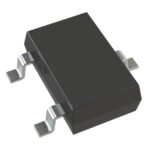 MMBD2838LT1

The activity of extra discounts on wholesale prices is in full swing…
Please fill in your contact information and we will send you the latest wholesale price list.





