 ChipApex | Global Electronic Components Supplier
SEARCH
Search Product
Search Post
— IC芯片 | 连接器 | 传感器 | 被动器件 —
Search productSearch post
— IC芯片 | 连接器 | 传感器 | 被动器件 —
Consult the customer manager about the wholesale price.
consultation hotline:86-132-6715-2157
email:[email protected]
Contact the product manager for consultation. One-stop consultation is available.
Do you want a lower wholesale price? Please send us your inquiry and we will reply immediately.
The MMBT5179 is an NPN RF bipolar junction transistor manufactured by onsemi, designed for high-frequency applications up to 2 GHz. It operates within a junction temperature range of -55°C to +150°C and features a maximum collector-emitter breakdown voltage (VCEO) of 12 V. The device supports a continuous collector current of 50 mA with a maximum power dissipation of 225 mW. Key electrical characteristics include a minimum DC current gain (hFE) of 25 at 3 mA and 1 V, and a typical noise figure of 5 dB at 200 MHz. Packaged in a surface-mount SOT-23-3 case, it integrates RF performance suitable for compact circuit designs.
Verify the specific ordering suffix against official onsemi documentation to confirm package type and tape/reel specifications. Ensure the component meets RoHS compliance requirements for your target market. Cross-reference the manufacturer part number with authorized distributor catalogs to confirm active status and availability before finalizing procurement plans.
Select this component when designing circuits requiring NPN RF performance at frequencies up to 2 GHz. Consider the 12 V collector-emitter voltage limit and 50 mA current capacity during biasing calculations. Evaluate the thermal management needs given the 225 mW power dissipation rating in the SOT-23-3 package. Compare noise figures against alternative devices if ultra-low noise is critical for the application.
The MMBT5179 belongs to onsemi's portfolio of discrete bipolar transistors tailored for RF and analog applications. It complements other small-signal transistors in the MMBT series, offering specialized high-frequency characteristics distinct from general-purpose logic or power switching devices. Its design focuses on balancing gain, noise, and speed within a standard surface-mount footprint.
Consult official onsemi substitution guides for verified equivalent parts. Do not assume functional compatibility with generic NPN transistors lacking specified RF parameters. Verify pinout alignment and electrical limits before implementing any cross-references.
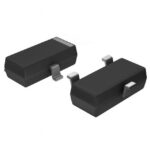 MMBT5179
The activity of extra discounts on wholesale prices is in full swing…
Please fill in your contact information and we will send you the latest wholesale price list.





