 ChipApex | Global Electronic Components Supplier
SEARCH
Search Product
Search Post
— IC芯片 | 连接器 | 传感器 | 被动器件 —
Search productSearch post
— IC芯片 | 连接器 | 传感器 | 被动器件 —
Consult the customer manager about the wholesale price.
consultation hotline:86-132-6715-2157
email:[email protected]
Contact the product manager for consultation. One-stop consultation is available.
Do you want a lower wholesale price? Please send us your inquiry and we will reply immediately.
The MMDT3906-7 is a dual PNP small-signal surface mount transistor manufactured by Diodes Incorporated. It utilizes epitaxial planar die construction and is housed in an SOT-363 molded plastic package. The device features a collector-base voltage (VCBO) of -40 V, a collector-emitter voltage (VCEO) of -40 V, and an emitter-base voltage (VEBO) of -5.0 V. Continuous collector current (IC) is rated at -200 mA with a power dissipation (Pd) of 200 mW. The junction-to-ambient thermal resistance (RθJA) is 625 °C/W. Operating and storage temperature ranges span from -55 to +150 °C. DC current gain (hFE) varies between 30 and 300 depending on collector current conditions.
Verify the specific ordering suffix '-7' against official manufacturer documentation to confirm tape and reel packaging quantities. Ensure that any visual markings or date codes align with the provided marking information table. Cross-reference the datasheet revision number to guarantee compliance with the latest electrical characteristics and mechanical dimensions before finalizing procurement orders.
Select this component when a matched pair of PNP transistors is required in a compact footprint. The SOT-363 package offers space efficiency compared to single discrete packages. Evaluate the 200 mW power dissipation limit and thermal resistance constraints for the intended ambient temperature environment. Confirm that the -40 V voltage ratings meet the circuit requirements.
This part belongs to the MMDT3906 series of dual PNP small signal transistors produced by Diodes Incorporated. It shares the same core electrical specifications as other variants in the family but differs in packaging format. The standard version is available in bulk tape and reel configurations suitable for automated surface mount assembly processes.
MMDT3906VC-7
The maximum collector-emitter breakdown voltage (V(BR)CEO) is -40 V.
The current gain-bandwidth product (fT) is typically 250 MHz under specified test conditions.
The product type marking code is K3N, followed by the date code marking.
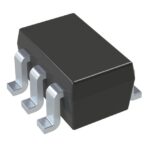 MMDT3906-7
The activity of extra discounts on wholesale prices is in full swing…
Please fill in your contact information and we will send you the latest wholesale price list.





