ChipApex | Global Electronic Components Supplier
SEARCH
Search Product
Search Post
— IC芯片 | 连接器 | 传感器 | 被动器件 —
Search productSearch post
— IC芯片 | 连接器 | 传感器 | 被动器件 —
Consult the customer manager about the wholesale price.
consultation hotline:86-132-6715-2157
email:[email protected]
Contact the product manager for consultation. One-stop consultation is available.
Do you want a lower wholesale price? Please send us your inquiry and we will reply immediately.
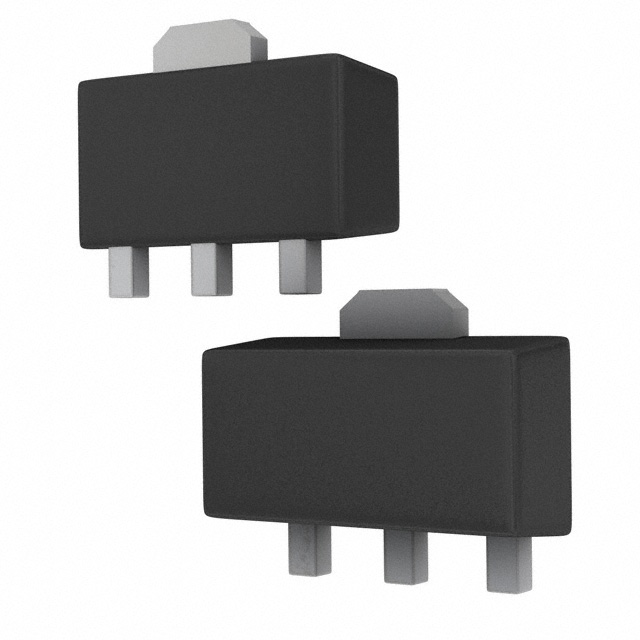
The MT3S111P(TE12L,F) is a Silicon-Germanium NPN epitaxial planar transistor designed for VHF-UHF low-noise and low-distortion amplifier applications. It operates with a collector-emitter voltage of 6 V and supports a continuous collector current of 100 mA. The device achieves a transition frequency (fT) of up to 8 GHz and delivers a typical insertion gain of 10.5 dB at 1 GHz. Its noise figure is typically 0.95 dB at the same frequency, while maintaining an output intercept point (OIP3) of 32 dBmW at 500 MHz. Power dissipation reaches 300 mW under standard conditions.
Verify component authenticity by checking markings against official Toshiba Semiconductor datasheets. Confirm package type PW-Mini matches SC-62 standards. Ensure electrostatic discharge precautions are applied during handling due to the high-frequency process sensitivity. Review reliability data before integration into final designs.
Select this component when designing circuits requiring low noise figures below 1 dB at 1 GHz. Consider the 6 V maximum collector-emitter voltage limit for biasing networks. Evaluate thermal management requirements as power dissipation ratings depend on mounting conditions. Verify compatibility with target operating frequencies between 500 MHz and 1 GHz.
This part belongs to the MT3S111 series of bipolar small-signal transistors manufactured by Toshiba Semiconductor. It represents a specialized silicon-germanium solution targeting radio frequency applications where signal integrity and minimal noise addition are critical design parameters.
Consult official Toshiba documentation for direct substitutes within the MT3S11x family. Verify pinout compatibility and electrical parameter overlaps before considering alternative manufacturers. Cross-reference absolute maximum ratings to ensure safe operational margins.
 MT3S111P(TE12L,F)
The activity of extra discounts on wholesale prices is in full swing…
Please fill in your contact information and we will send you the latest wholesale price list.