 ChipApex | Global Electronic Components Supplier
SEARCH
Search Product
Search Post
— IC芯片 | 连接器 | 传感器 | 被动器件 —
Search productSearch post
— IC芯片 | 连接器 | 传感器 | 被动器件 —
Consult the customer manager about the wholesale price.
consultation hotline:86-132-6715-2157
email:[email protected]
Contact the product manager for consultation. One-stop consultation is available.
Do you want a lower wholesale price? Please send us your inquiry and we will reply immediately.
The NE68830-T1-A is a surface mount NPN silicon high frequency transistor from the NE688 series, manufactured by CEL. It is designed for low cost amplifier and oscillator applications requiring low noise figures, high gain, and wide dynamic range. The device features a minimum noise figure of 1.5 dB at 2.0 GHz with VCE=3V and IC=7mA. It supports a maximum collector current of 100 mA and operates up to 5 GHz. Key electrical parameters include a gain bandwidth product (fT) of 9 GHz at VCE=3V/IC=20mA, and an insertion power gain of 6.5 dB at 2.0 GHz under the same conditions. Absolute maximum ratings specify a collector-to-base voltage of 9 V, collector-to-emitter voltage of 6 V, and total power dissipation of 150 mW.
Verify component authenticity through official manufacturer channels or authorized distributors. Confirm package type matches design requirements as the NE688 series offers multiple surface mount options. Check datasheet revision dates to ensure parameter accuracy. Ensure proper ESD handling procedures are followed during storage and assembly due to device sensitivity.
Select this component when low noise and high linearity are prioritized for RF stages. Compare fT and NFmin values against specific frequency requirements. Consider thermal resistance and power derating curves for ambient temperature constraints. Evaluate available package styles to match PCB layout constraints while maintaining electrical performance targets.
The NE68830-T1-A belongs to the broader NE688 series of NPN epitaxial silicon transistors produced by California Eastern Laboratories (CEL). This series includes variants like NE68818, NE68819, NE68833, and NE68839, each offering different package outlines such as SOT-343 or SOT-23 styles. The series is characterized by consistent electrical performance across packages, tailored for cost-effective high-frequency solutions.
Publicly confirmed substitute part numbers for the NE68830-T1-A are not available in the provided documentation. Designers should consult the manufacturer directly for recommended alternatives or cross-reference compatible devices based on identical pinout and electrical specifications.
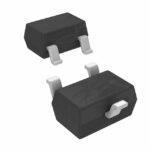 NE68830-T1-A
The activity of extra discounts on wholesale prices is in full swing…
Please fill in your contact information and we will send you the latest wholesale price list.





