 ChipApex | Global Electronic Components Supplier
SEARCH
Search Product
Search Post
— IC芯片 | 连接器 | 传感器 | 被动器件 —
Search productSearch post
— IC芯片 | 连接器 | 传感器 | 被动器件 —
Consult the customer manager about the wholesale price.
consultation hotline:86-132-6715-2157
email:[email protected]
Contact the product manager for consultation. One-stop consultation is available.
Do you want a lower wholesale price? Please send us your inquiry and we will reply immediately.
The PMBTA42DS-Q is a high-voltage NPN/NPN double transistor housed in a compact SOT457 (SC-74) TSOP6 surface-mounted device plastic package. It features two electrically isolated transistors within a single component, offering a collector-emitter voltage of 300 V and a continuous collector current of 100 mA per transistor. The device supports a peak collector current of 200 mA for single pulses up to 1 ms. Qualified according to the AEC-Q101 standard, it is designed for robust performance in automotive environments. Key electrical characteristics include a DC current gain ranging from 25 to 40 under specified conditions and a transition frequency of 50 MHz.
Verify the specific ordering suffix against the manufacturer's official documentation to ensure correct packaging configuration. Confirm that the AEC-Q101 qualification status aligns with your project's automotive reliability requirements before finalizing procurement decisions.
Select this component when space-constrained designs require dual isolated transistors with high voltage ratings. Ensure the application operates within the 300 V collector-emitter limit and 100 mA continuous current constraints. Verify thermal management strategies are adequate for the specified junction-to-ambient resistance values.
This part belongs to Nexperia's portfolio of high-voltage discrete semiconductors designed for general-purpose switching and amplification. It serves as a compact alternative to using separate discrete transistors, simplifying PCB layout while maintaining high voltage isolation between the two internal channels.
Check for direct equivalents such as the PMBTA92 PNP complement or other AEC-Q101 qualified NPN/NPN double transistors in the SOT457 package. Ensure pinout compatibility and matching voltage/current ratings before substitution.
The maximum collector-emitter voltage (VCEO) is 300 V with the base open.
No, the device contains two electrically isolated transistors within the same package.
Yes, it is qualified according to the AEC-Q101 standard and recommended for automotive applications.
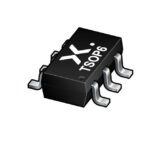 PMBTA42DS-QH
The activity of extra discounts on wholesale prices is in full swing…
Please fill in your contact information and we will send you the latest wholesale price list.





