 ChipApex | Global Electronic Components Supplier
SEARCH
Search Product
Search Post
— IC芯片 | 连接器 | 传感器 | 被动器件 —
Search productSearch post
— IC芯片 | 连接器 | 传感器 | 被动器件 —
Consult the customer manager about the wholesale price.
consultation hotline:86-132-6715-2157
email:[email protected]
Contact the product manager for consultation. One-stop consultation is available.
Do you want a lower wholesale price? Please send us your inquiry and we will reply immediately.
The PMEG4005CT,215 is a dual Schottky barrier rectifier in a common cathode configuration, housed in an SOT23 surface-mount package. It features an integrated guard ring for stress protection. Key electrical parameters include a maximum reverse voltage of 40 V and an average forward current rating of 0.5 A per diode. The typical forward voltage is 410 mV at 500 mA, with a maximum reverse current of 100 µA at 40 V. The device supports junction temperatures up to 150 °C and operates within an ambient temperature range of -55 °C to +150 °C.
Verify the specific ordering suffix
Select this component for designs requiring a compact dual Schottky solution with low forward voltage drop. Ensure the application does not exceed the 40 V reverse voltage or 0.5 A average forward current limits per diode. Consider thermal management strategies, as reverse power losses can be significant in some operating conditions. Verify that the non-automotive qualification status aligns with the target application requirements.
This part belongs to Nexperia's PMEG series of low VF Schottky barrier rectifiers. The PMEG4005CT specifically provides a dual-diode configuration in a standard SOT23 package, offering a space-saving alternative to discrete single diodes. It is designed for general-purpose electronics rather than automotive-grade environments, distinguishing it from the qualified -Q variants within the same product family.
For automotive applications, consider the PMEG4005ET-QR or similar qualified alternatives. Direct pin-compatible replacements should be verified against specific forward voltage and reverse current tolerances to ensure circuit performance remains within acceptable limits.
No, the PMEG4005CT is not automotive qualified. It is intended for general-purpose applications. Automotive versions are available under different part numbers with the -QR suffix.
Pin 1 is Anode 1, Pin 2 is Anode 2, and Pin 3 serves as the Common Cathode for both diodes.
The typical reverse recovery time (trr) is 13 ns, measured under specific test conditions of IF = 10 mA and IR = 10 mA.
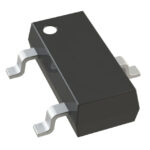 PMEG4005CT,215
The activity of extra discounts on wholesale prices is in full swing…
Please fill in your contact information and we will send you the latest wholesale price list.





