 ChipApex | Global Electronic Components Supplier
SEARCH
Search Product
Search Post
— IC芯片 | 连接器 | 传感器 | 被动器件 —
Search productSearch post
— IC芯片 | 连接器 | 传感器 | 被动器件 —
Consult the customer manager about the wholesale price.
consultation hotline:86-132-6715-2157
email:[email protected]
Contact the product manager for consultation. One-stop consultation is available.
Do you want a lower wholesale price? Please send us your inquiry and we will reply immediately.
The PRF947,115 is a silicon NPN wideband transistor designed for GHz-range RF front-end applications. It features a surface-mount SOT323 package with gold metallization for reliability. Key electrical parameters include a transition frequency (fT) of 8.5 GHz at IC=15 mA and VCE=6V, and a maximum unilateral power gain (GUM) of 16 dB at 1 GHz under the same conditions. The device exhibits a typical noise figure of 1.5 dB at 1 GHz with IC=5 mA. Limiting values specify a collector-base voltage (VCBO) of 20 V, collector-emitter voltage (VCEO) of 10 V, and total power dissipation of 250 mW at a soldering point temperature of 60 °C.
Verify component authenticity through authorized NXP distributors or certified suppliers. Confirm the marking code 'V0' on the SOT323 package matches the datasheet specifications. Ensure storage and handling procedures comply with moisture sensitivity levels to prevent damage prior to soldering. Request batch-specific test reports if required for quality assurance protocols.
Select this transistor for designs requiring high gain and low noise in the 1-2 GHz range. Verify that the operating collector current aligns with the specified bias points for optimal fT and GUM performance. Consider the thermal resistance of 460 K/W when designing heat dissipation strategies, as power dissipation is limited to 250 mW. Ensure impedance matching networks account for the provided stability circles and S-parameter data.
Originally manufactured by Philips Semiconductors, now part of NXP Semiconductors. The PRF947 is a specialized discrete semiconductor component intended for high-frequency analog and digital signal processing. It serves as a critical active element in RF amplification stages where size constraints and signal integrity are paramount.
No direct public substitute part numbers are documented in the source material. Evaluate alternative UHF transistors based on comparable fT, gain, and package compatibility. Verify that any replacement meets the specific voltage and current limiting values required by the original circuit design.
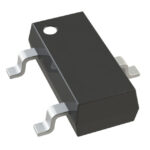 PRF947,115
The activity of extra discounts on wholesale prices is in full swing…
Please fill in your contact information and we will send you the latest wholesale price list.





