 ChipApex | Global Electronic Components Supplier
SEARCH
Search Product
Search Post
— IC芯片 | 连接器 | 传感器 | 被动器件 —
Search productSearch post
— IC芯片 | 连接器 | 传感器 | 被动器件 —
Consult the customer manager about the wholesale price.
consultation hotline:86-132-6715-2157
email:[email protected]
Contact the product manager for consultation. One-stop consultation is available.
Do you want a lower wholesale price? Please send us your inquiry and we will reply immediately.
The RGW80TS65CHRC11 is a single N-channel Field Stop Trench IGBT manufactured by ROHM Semiconductor, housed in a TO-247N-3 package for through-hole mounting. It features an integrated SiC-SBD (Silicon Carbide Schottky Barrier Diode) to enhance switching performance. The device supports a maximum collector-emitter voltage of 650 V and a continuous collector current of 40 A at 25°C. Key electrical parameters include a typical collector-emitter saturation voltage of 1.9 V and a power dissipation rating of 214 W. It operates within a temperature range of -40°C to +175°C and meets AEC-Q101 automotive qualification standards.
Verify the specific suffix 'CH' indicates the hybrid SiC-SBD configuration distinct from standard FRD variants like 'EH'. Confirm AEC-Q101 compliance requirements for your target application. Check for end-of-life status as some sources indicate scheduled obsolescence for this specific part number. Ensure thermal management design accounts for the 214 W dissipation rating in the TO-247N package.
Select this component when low reverse recovery characteristics are critical for efficiency in high-frequency switching applications. The integrated SiC diode offers superior performance over traditional fast recovery diodes. Consider the TO-247N package size for board space constraints. Compare against standard IGBTs if cost is a primary driver and SiC benefits are not required.
This part belongs to ROHM's RGTV/RGW series, which focuses on eliminating the trade-off between low conduction loss and high-speed switching. The series is engineered for high reliability in automotive and industrial environments, providing smooth soft-switching behavior to ease design burdens for engineers developing high-power conversion systems.
Public confirmed substitute part numbers are not available in the provided documentation. Standard replacements may include other ROHM Field Stop Trench IGBTs with similar voltage and current ratings, but the specific SiC-SBD integration requires careful evaluation of alternative hybrid devices.
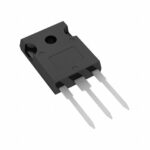 RGW80TS65CHRC11
The activity of extra discounts on wholesale prices is in full swing…
Please fill in your contact information and we will send you the latest wholesale price list.





