ChipApex | Global Electronic Components Supplier
SEARCH
Search Product
Search Post
— IC芯片 | 连接器 | 传感器 | 被动器件 —
Search productSearch post
— IC芯片 | 连接器 | 传感器 | 被动器件 —
Consult the customer manager about the wholesale price.
consultation hotline:86-132-6715-2157
email:[email protected]
Contact the product manager for consultation. One-stop consultation is available.
Do you want a lower wholesale price? Please send us your inquiry and we will reply immediately.
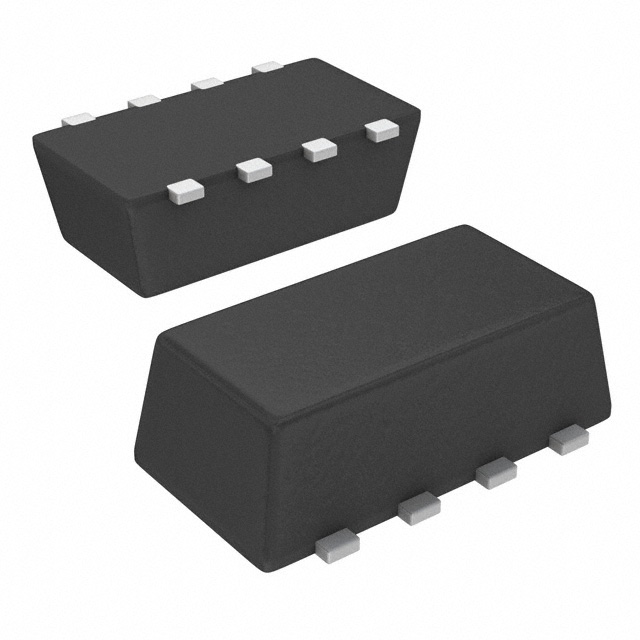
The Vishay Siliconix SI5933CDC-T1-GE3 is a dual P-channel MOSFET in a leadless 1206-8 ChipFET package. It features a -20 V drain-source voltage and a maximum continuous drain current of -3.7 A at TC = 25 °C. The on-state resistance is 0.144 Ω at VGS = -4.5 V, with a typical total gate charge of 4.1 nC. Operating junction temperature ranges from -55 °C to 150 °C, and the device complies with RoHS directives.
Verify component authenticity by checking the marking code against official datasheet specifications. Confirm compliance with Halogen-free standards per IEC 61249-2-21 and RoHS Directive 2002/95/EC. Ensure proper handling procedures are followed due to the exposed copper terminals characteristic of the leadless singulation process.
Select this component when high-density packaging is required alongside robust thermal management capabilities. The 1206-8 form factor allows for an 80% reduction in body area compared to traditional packages without sacrificing power dissipation limits. Evaluate PCB copper spreading to optimize junction-to-ambient thermal resistance for specific load conditions.
This part belongs to the Vishay Siliconix ChipFET family, which integrates power semiconductor performance into standard passive component footprints. The dual-channel architecture consolidates two independent P-channel MOSFETs into a single surface-mount device, streamlining circuit layout for multi-rail or differential applications.
Direct replacements must match the -20 V rating, dual P-channel topology, and 1206-8 leadless package outline. Verify that alternative components maintain equivalent RDS(on) values and thermal resistance characteristics to ensure identical board space utilization and heat dissipation profiles.
Manual soldering with a soldering iron is not recommended. The device requires reflow soldering processes adhering to the specified peak temperature of 260 °C.
The 1206-8 ChipFET offers steady-state junction-to-ambient thermal resistance identical to the SO-8 package (approximately 90 °C/W on a 1-inch square FR4 board), despite having a significantly smaller physical footprint.
 SI5933CDC-T1-GE3
The activity of extra discounts on wholesale prices is in full swing…
Please fill in your contact information and we will send you the latest wholesale price list.