 ChipApex | Global Electronic Components Supplier
SEARCH
Search Product
Search Post
— IC芯片 | 连接器 | 传感器 | 被动器件 —
Search productSearch post
— IC芯片 | 连接器 | 传感器 | 被动器件 —
Consult the customer manager about the wholesale price.
consultation hotline:86-132-6715-2157
email:[email protected]
Contact the product manager for consultation. One-stop consultation is available.
Do you want a lower wholesale price? Please send us your inquiry and we will reply immediately.
The TDA7492MV is a mono BTL Class-D audio amplifier designed for home systems and docking stations. It operates on a single supply voltage ranging from 10 V to 26 V. The device delivers 50 W continuous output power at RL = 6 Ω, THD = 10%, and VCC = 25 V. At RL = 8 Ω under the same conditions, it provides 40 W continuous output power. The amplifier achieves high efficiency of up to 90%. It features four selectable fixed gain settings: 21.6 dB, 27.6 dB, 31.1 dB, and 33.6 dB. The component utilizes an exposed-pad-down (EPD) PowerSSO-36 package.
Verify the specific ordering code against the required packaging format. The standard tube version is designated as TDA7492MV, while the tape and reel variant is identified as TDA7492MV13TR. Confirm that the operating temperature range aligns with system requirements, as this part is rated for 0 to 70 °C. Ensure the application circuit supports the exposed-pad-down thermal dissipation method specified in the datasheet.
Select this component for applications requiring a single-channel bridge-tied-load configuration. The wide input voltage range accommodates various power supply architectures. Consider the available gain settings to match the source signal level without additional amplification stages. The differential input architecture helps maintain signal integrity in electrically noisy environments typical of consumer electronics.
This device belongs to the TDA7492 family of Class-D audio amplifiers manufactured by STMicroelectronics. It shares functional similarities with other members like the TDA7492P but differs in package type and thermal characteristics. The TDA7492MV specifically targets cost-sensitive applications where efficient heat dissipation without large heatsinks is critical.
TDA7492MV13TR serves as the tape-and-reel equivalent of the tube-packaged TDA7492MV. Both variants share identical electrical specifications and pinouts. Verify that any alternative replacement maintains compatibility with the exposed-pad-down mounting style and thermal requirements.
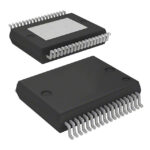 TDA7492MV
The activity of extra discounts on wholesale prices is in full swing…
Please fill in your contact information and we will send you the latest wholesale price list.





